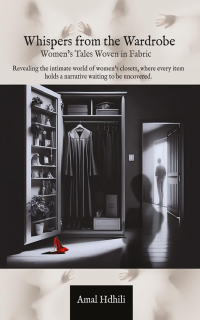
What inspired you to write Whispers from the Wardrobe—and why did you choose forgotten objects as the narrative lens?
The idea came from something very personal. I’ve always had this habit of holding onto small objects—papers, letters, even clothes that no longer fit—because they feel like they carry pieces of people and moments inside them. When I looked at these forgotten things, I realized they were like silent witnesses. They watched us laugh, cry, fall in love, fall apart… but they never got to speak. So, I gave them a voice. Writing through the eyes of forgotten objects allowed me to tell human stories in a new way, without judgment or bias—just the quiet truth that only an observer can see.
How did your background in business and marketing influence the structure or themes in your storytelling?
Business gave me discipline, and marketing taught me how to connect. In marketing, you don’t just describe a product—you find the story behind it, the thing that will make someone care. I think that influenced the way I write. Each story in my book is structured with a purpose: to catch the reader’s attention, to touch them, and to leave something behind when the page is turned. My corporate background also shaped the rhythm of my writing—clear, structured, but always with room for emotion, because that’s what people really remember.
Many of your stories seem to center around silence and the unspoken. Why is that such a powerful theme for you?
Because silence is everywhere in our lives. It’s in the long pause after a fight, in the moment before someone leaves, in the quiet acceptance of something we cannot change. Growing up, I noticed how silence often carried more meaning than words. It could comfort you or break you. That stayed with me. In my stories, I wanted to capture that hidden language of silence—the way it holds unspoken dreams, regrets, and truths that are too heavy to say out loud. For me, writing is giving silence the words it never had.
How do you balance poetic language with storytelling in your collection? Was that a natural fusion for you or a challenge?
It feels natural for me to write poetically—I don’t force it, it’s just how words come out. But I also know a story needs clarity. Sometimes, I’ll write a scene almost like a poem, full of rhythm and imagery, and then step back and make sure the reader can still follow the thread of the story. Other times, the story is so strong it doesn’t need many flourishes, and I let it stand on its own. I see it like music—you need both melody and lyrics. My writing is where those two meet.
What emotions or realizations do you hope linger with readers after finishing your book, “Whispers from the Mirror”?
I want them to feel like they’ve been let in on a secret—that the objects around them, the ones they take for granted, are alive with memory. I hope they’ll pause in front of their own mirror and wonder: what has this mirror seen of me that I have forgotten? More than anything, I want them to feel less alone. Life can be isolating, but my stories are a reminder that even the smallest, most silent things are carrying us with them.
As a Tunisian author living in Turkey, how do your cultural experiences shape your voice as a writer?
Living between two cultures has been such a gift to my writing. Tunisia gave me warmth, family stories, and the feeling of belonging to an old tradition of storytelling. Turkey gave me a new language, new perspectives, and the chance to see myself as both an insider and outsider. That “in-between” space is where my voice was born—I write with nostalgia for what I left behind, and curiosity for what I discovered here. My identity is a bridge, and my stories live on that bridge.
How do themes of identity and memory intersect in your stories, especially in a world that often asks us to move on too quickly?
To me, who we are is nothing more than the memories we carry. But the modern world pushes us to keep moving forward, to forget, to always be “new.” My stories push back against that. They say: remember. Remember the dress you never wore, the words you never said, the objects that held your life quietly in the background. Because those memories, even the ones we hide, shape our identity. Without them, we are unfinished.
Do you feel your writing gives voice to a particular cultural or generational silence? If so, how?
Yes, in many ways. Coming from Tunisia and living in Turkey, I’ve noticed that cultures often carry their emotions quietly. Grief, longing, even certain joys are not always spoken—they live in gestures, in traditions, or in objects that stay in families for decades. Generationally, too, I’ve seen silence passed down. My parents’ generation believed endurance meant keeping things inside, while my own generation is beginning to name those hidden feelings—loneliness, identity, mental health.Through my stories, I try to give these silences a voice. Forgotten objects become bridges between cultures and generations: a wardrobe can hold the weight of tradition, a mirror can reflect the unspoken changes over time. In letting them speak, I hope to honor the dignity of old silences while also opening space for new conversations.
Have you always seen yourself as a storyteller? When did you first realize you wanted to write?
Yes, I think storytelling has always been part of me, even before I had the words for it. As a child, I was always scribbling in notebooks—little essays, diary entries, even letters to myself. I don’t think there was one single moment when I decided, “I want to be a writer.” It was more like writing never left me—it followed me through childhood, through my studies, through my work. Even when life got busy and words had to wait, they were always there in the background. The first time I truly claimed it was when I sat down to write Whispers from the Wardrobe. That was when I stopped hiding behind journals and realized: this isn’t just a habit, it’s who I am.
What’s your writing routine like? Do you write from emotion, memory, or observation—or all three?
I don’t have a strict routine, but I do have a rhythm. I carry stories in my head during the day—while walking, cooking, even working—and then at night, when the world is finally quiet, I sit down and let them out. I write from memory, because memories don’t leave me alone. I write from emotion, because that’s the fire. And I write from observation, because the smallest details—a glance, a sound, a pause—can unlock a whole story.
Which authors or poets have had the greatest influence on your style or perspective?
Gibran Khalil Gibran, without a doubt. I started reading his poems at a young age, and what amazed me was how they made sense even then. His words were simple enough for me to understand as a child, yet when I return to them now, they carry layers of meaning I couldn’t have seen before. That’s his gift—combining depth with simplicity, making wisdom feel both timeless and intimate.I think that’s what influenced me most. I want my own writing to reach people the same way: to be easy to read, yet full of echoes that stay with you long after. Gibran showed me that words don’t have to be complicated to touch the soul—they just have to be true.
As someone deeply reflective, how do you personally navigate the line between catharsis and vulnerability when writing?
For me, writing has always been a release—it’s where I let the emotions I can’t say out loud find a safe place. That’s the catharsis. But at the same time, once those words are on paper, they’re no longer mine alone. Sharing them means opening myself up to others, and that’s where the vulnerability comes in.I try not to overthink it while I’m writing. I let everything pour out, even the parts that feel raw or uncomfortable. Later, when I read it back, I ask myself: does this truth belong only to me, or could it speak to someone else too? If it can touch another person, then I leave it there, even if it feels exposing.It’s not always easy, but I’ve learned that the places where I feel most vulnerable are often the places where readers connect most. And that makes the risk worth it—because it means my words are not just healing me, they’re reaching someone else too.
Are there any particular stories or voices you feel compelled to explore in your next work?
Yes. After giving the wardrobe a voice, I couldn’t stop thinking about the mirror. The wardrobe was a keeper of secrets—it hid things, preserved them, held onto memories people tried to put away. The mirror, on the other hand, is the opposite. It doesn’t hide anything; it exposes. It shows people exactly as they are in the moment—whether they’re ready to face it or not.That difference excites me. The wardrobe whispers from the shadows, while the mirror speaks through reflection. One guards the past, the other forces the present. Exploring
that contrast feels like the natural next step for me, because together they show two sides of how we live: what we bury, and what we can’t escape seeing.
Do you plan to continue blending poetic narrative with fiction, or are you exploring other genres?
Poetic narrative feels like home to me. It’s the way my thoughts naturally arrive—in images, in rhythm. I think that will always be part of my voice. But I’m also curious to explore essays, personal reflections, maybe even non-fiction. Still, no matter what form I take, storytelling will be at the heart of it.
What has your AllAuthor experience been like so far? What are some highlights?
It’s been encouraging. Writing can feel lonely sometimes—you write, you wonder if anyone is really listening. AllAuthor reminded me that there’s a whole community out there, both writers and readers, who care about stories. Seeing my book next to so many others was a highlight—it felt like being part of a bigger conversation, not just me whispering alone into the world.