Your books explore identity, justice, and resilience from deeply personal and historical perspectives. What inspired you to make these themes the foundation of your writing?
The real spark was watching the original Shaft — Richard Roundtree — at exactly the right moment in my life. That film made me love private-eye stories, and it made me want to write a story about a Black private eye. Years later in college, somebody told me I'd make a good author. I didn't believe them — my upbringing hadn't taught me to see myself that way. It took me a long time to catch up to what that person saw before I could.
As an Army veteran, how has your military experience influenced the way you develop characters and tell stories?
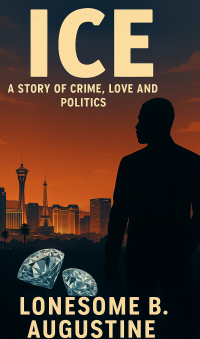
The Army gave me the discipline to finish what I started. ICE took me over ten years to write, and it was that same structure that kept me at it. It also gave me the material — there's a scene where Ice is about to encounter Iraqi soldiers, and I could only write that scene the way I did because of my own time in the service.
Dark Prairie shines a light on Black historical figures often overlooked in traditional Western narratives. What motivated you to reclaim this forgotten chapter of history?
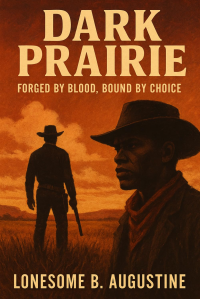
It started almost like a dare — someone wondered aloud if I could write a Black Western. That question sent me into research, and that's where I found Bass Reeves, Nat Love, Mary Fields, Cherokee Bill. But the one I wasn't even looking for was John Ware — a man history treats more as a Canadian hero than an American one, partly because he was a pacifist, and a cowboy who doesn't shoot doesn't fit the story America likes to tell about itself. He became my main protagonist.
What kind of research went into writing Dark Prairie, and were there any historical discoveries that particularly surprised or moved you?
It took more than a search bar — a lot of what I needed wasn't online at all, so I spent real time in libraries pulling actual books. And almost everything I found surprised me, because I had no idea what my own history held. Mary Fields was the first Black mail carrier in the United States — most people don't know that. And Cherokee Bill's story, the sheer violence of his rampages, stopped me in my tracks and pushed me to dig even deeper.
In ICE, you blend crime, politics, and social commentary. What drew you to the thriller genre as a way of exploring complex issues?
The thriller is what I read myself — John Grisham, Frederick Forsyth's The Day of the Jackal, that lane. So when it came time to write, that genre was the only real option for me. It also pushed me into research on things I knew nothing about. I built the plot around a fictionalized version of the Millennium Challenge Corporation — a U.S. philanthropic entity — and asked the question: what if another country tried to manipulate an organization like that for its own advantage? The thriller was the only vehicle that let me explore that.
Your work frequently examines the emotional and spiritual struggles faced by Black men. Why do you believe these conversations are especially important today?
Society is shifting for the Black man, generationally and culturally. My generation was taught to be strong and not cry. This generation has to accept emotion and vulnerability just to fully participate in today's world. I believe that shift needs conversation — partly to ease the transition, and partly to carry history's past into the present, because we have to understand yesterday before we can deal with tomorrow. That's a conversation I put directly into both Dark Prairie and ICE.
How do you balance creating compelling fiction while addressing real-world issues such as justice, race, and faith?
Honestly, that's a tough one. I start with the issue I want to address and build the story around it — though it's never fully organic, because each book is contingent on what I've already written before it. But somehow, justice, race, or faith always rears its head. I think that's just personal to me — race, because I'm Black; justice, because of the injustices I've experienced; faith, because it's central to who I am. I don't balance them so much as they're innate to my nature.
Many readers describe your stories as both entertaining and thought-provoking. What emotions or reflections do you hope readers take away after finishing one of your books?
First, realism — my books carry a lot of it. Dark Prairie is historical fiction; every character was real, every situation was real. I only invented the connections that got them all into Ft. Worth together. But entertainment matters just as much to me. Realism lets a reader insert themselves into the story, and entertainment is what keeps them there. If nothing else, I want them to close the book with something from their own life they can hold up against what I've written.
Your writing often highlights resilience in the face of adversity. How has resilience shaped your own life and creative journey?
I didn't believe, as a child or a young man, that I had what it took to write. But being raised by a single mother built a resilience that doesn't live in everyone, and combined with the military, it gave me the grind I needed to finish these books. I was raised without knowing what having a father in the house even looked like. All of it together is what gave me the resilience to write these stories — and that resilience is what guides my life as a whole today.
Faith plays an important role in many of your themes. How has your personal faith influenced your storytelling and worldview?
My faith is everything to me. I don't know if it's just age, but belief in God is the one thing I hold onto above all else — even above my wife and children, because without Him, I couldn't take care of them anyway. That faith shapes my daily discipline, how I write, and who I am as a person. My moral center is going to show up in my characters because that's who I am. I wouldn't know how to write any other way.
As both an author and a speaker, how do the messages you share on stage complement the stories you write on the page?
They're the same message in two different rooms. What I feel, I speak. What I speak, I write. The subject matter demands that I speak the same way I write — so it's not really that one feeds the other, it's that the books feed the speeches as much as the speeches feed the books.
What challenges have you faced as a Black author telling stories that challenge conventional narratives and encourage deeper conversations?
The real friction is with the publishing industry itself. There's an ‘acceptable’ way to write across every genre and platform, but if you've ever talked to a Black person, you know the dialect, the tone, the words — they're used differently. When I write a Black story in Black language, Black terms, Black slang, that's what makes Black male readers feel entrenched in the story. Getting a publisher to spell a word the way I spell it isn't quite a battle, but it's a real pushback. My readers tell me they appreciate hearing the terms they actually know — so it's important to me to keep writing that way without compromise.
Which character from your novels has stayed with you the longest, and what makes that character especially meaningful to you?
Isaac ‘Ice’ Moore. I didn't originally intend for him to carry a series, but he's stayed with me so much that I now want to keep writing stories built around him. John Ware's discovery was just as instrumental — learning that one in four cowboys were Black reshaped how I understood the whole West, especially since I rarely, if ever, saw a Black cowboy in an American Western growing up. But Ice is the one that hasn't let go.
Looking ahead, what stories or projects are you most excited to share with your readers, and what can they expect from you next?
Next up is my novel Touch. I don't want to give away too much, but it's a spiritually based story, and I expect it to stand as large — if not larger — than the two I've already put out. I'm writing this one from a more personal, almost autobiographical place. It follows a Black oncology nurse who discovers an extraordinary power born out of tragedy, and that power builds to a real dilemma for him by the end. That's next — unless Ice rears his head first.
What do you like the most about services provided by AllAuthor?
I use Amazon, Goodreads, BookBub, all of them — but what stood out about AllAuthor is the exposure and the promotion, and how easy they make it to actually get that work out. And honestly, just being asked to do this interview is more than the others have ever offered. So thank you, AllAuthor.