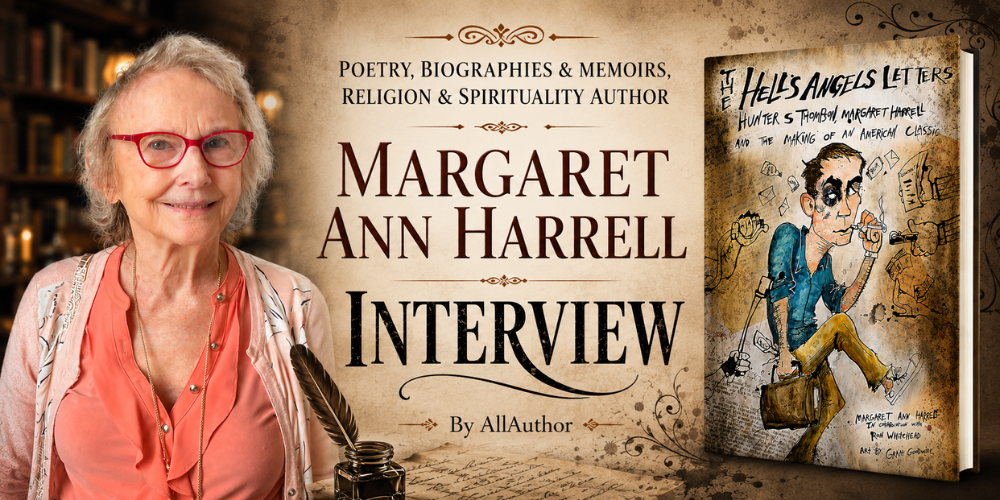
Your book The Hell's Angels Letters offers rare insight into Hunter S. Thompson—what surprised you most when revisiting his letters after so many years?
First, I was surprised I kept them through so many travels—living in Morocco, in Switzerland, in Belgium—and that when kept for years in a little storage unit, they escaped the fire ants. Then I was surprised that they “replaced” my memory, filling in a big segment of my personal history much better than I ever could.
How did your personal relationship with Hunter shape the narrative and tone of this book?
It totally shaped it. In this book, that relationship was front and center, and the color scans of his letters meant he wrote one quarter of the book!
The book presents Hunter during his early struggles—what do you think modern writers can learn from his publishing journey?
I watch people put out a lot of money in “Done for You” programs, being shepherded from how to write the book to getting it over the finish line. And that’s one way. But the way Hunter “rose from the ranks,” the way I did too, is a total immersion in life that, at the end, winds up producing an article, a book and then more books, and finally getting them to the public. The books stay inside Life all the way through, and even while being written or edited, the book still makes room for Life to enter in.
Can you describe a moment from the letters that felt especially raw or revealing about Hunter’s personality?
Moments when I worked with him as a copy editor, long distance, when he didn’t know what I looked like, moments when, decades later, I went to Owl Farm to renew our relationship and again he wasn’t concerned with how the years might have changed me. He thought we “knew” each other, in depth, with a “connection,” electricity, once and for all. Hunter wanted, in any relationship, to “make a connection.”
What was the biggest challenge in curating and presenting these letters as both historical documents and a compelling story?
Getting them published. Otherwise, it was delightful.
What was it like collaborating with Ron Whitehead on this project?
Ron has become a true friend. We collaborate to this day, in the sense that I still ask him to read my work in manuscript, and he gives the “green light,” which makes me feel I am “on my way” – ready to go public – in any project. And he reads my audiobooks, including this one, side by side with me. He played Hunter in the audiobook. In the Letters collaboration, he was there with unfailing energy every time mine lagged. I, in particular, need that.
Your work blends memoir, biography, and archival material—how do you balance authenticity with storytelling?
Authenticity is always at the top. But I find no contradiction in that and storytelling if the story is strong enough. Then it’s up to the author to have expertise enough to choose exciting language worthy of the story. Grippingly inside it. Stirringly finding the words and shape.
How has your writing process evolved from Keep This Quiet! to your more recent publications?
Keep This Quiet! has paraphrases of snippets of Hunter’s letters. Color scans would have been too expensive. And in KTQ! I wanted to feature a nest of three males—genius level—I met, clustered together, in my mid-twenties. All shared an unswerving insistence on being themselves—i.e., were authentic, if you wish. They were fearless in that way. I hadn’t the skills to always fearlessly express myself, at the time. I wanted to, though. I knew there was no other way to “be myself.” At the Jung Institute in Zurich, I came to realize that there was male energy inside me—the animus, in Jungian terms—looking out at these three males and identifying with them. So something in me was activated by their presence, soaking up nourishment from them, trying to pass to me from the outside what I had in spades on the inside and hadn’t looked deeply enough inside to find it. By contrast, the Letters book puts the spotlight squarely on Hunter (and his emergence into fame, by way of our relationship, starting with the letters he wrote while I was at Random House, assigned to work with him on Hell’s Angels).
In Keep This Quiet! IV: Ancient Secrets Revealed, you explore subtle energy and “Computer PK.” What led you to embrace and write about these phenomena?
The same way I was attracted strongly to the three males in New York City - Hunter, Milton, Jan – I was drawn to spiritual experiences. Once Milton Klonsky died, I had to totally rethink what I believed about life, because he didn’t appear to be dead. I felt I was still in contact with him. And from that intense questioning, I began to “attract” spiritual experiences that answered my question. “Computer PK” was one of these experiences – a fascinating dive into printing with a printer whose output did not precisely match what was on the screen.
Your time at the C. G. Jung Institute included a “Confrontation with the Unconscious.” How did that experience reshape your worldview and writing?
You have really dug into my life. That experience totally reshaped my life and worldview. Everything after that started from that point: “If THIS is true – if THIS experience happened to me – unless I close my mind and say it didn’t, what new do I now know about life?” I had to ask. And proceed from there. In other words, I had become conscious of more points of view than I had even known existed.
Many of your books merge spirituality with lived experience—do you see yourself more as a storyteller or a guide?
I think you start down on the ground, where stories are. Life embeds itself in your surroundings, and from there with enough lived experience, if you believe your own experience and test it – before the reader’s eyes – you cannot help but be a guide to some people. And then more. But with me, people generally like firsthand experience. I think that has something to do with the vibes I give off: the transmission and frequency. However, I’ve now begun to, without trying to, insert frequencies into my books.
You’ve lived in places like Morocco and Zurich—how have these cultural experiences influenced your creative voice?
They have widened me again. I am interested in wherever I live. So it definitely influences what I know, and that helps shape my voice.
Being a three-time fellow at MacDowell Colony is a significant achievement—how did that environment shape your work?
I was very young, and MacDowell was a godsend. To be able to be picked out as “a writer” was wonderfully encouraging. And to have the experience of writing in a woodsy cottage all day with a little food basket placed at my door, then at night having discussions with fellow writers (older, established ones), was unforgettably nourishing.
What inspired you to narrate your own audiobooks, and how does performing your work change the experience for you?
First, I had to realize I could read aloud effectively. I didn’t know that. But I did know – getting back to authenticity – that to read my own works means I convey my own intonations and vibration.
Lastly, how has your experience with AllAuthor supported your journey as a writer? Any standout features or opportunities that you’ve found especially helpful?
This interview, for one. I am very impressed with the quality of the questions. And you sought me out, patiently and kindly waiting till I had the time to reply. The opportunities are there, if the writer takes advantage of them. I do highly recommend All Author. You have a readymade audience. And an author does well to take advantage of readymade, interested audiences.