From academia to fantasy fiction—what inspired the leap, and what challenges did you face in making the switch?
Academic writing was more of a career thing. I enjoyed the challenge, but found it restrictive as it’s all about facts with little room for imagination. I always loved to read fantasy, however, ever since my brother lent me Lord of the Rings when I was just 18. It seemed a natural move to start writing as well as reading the genre.
You’ve co-authored two non-fiction books—how has your academic background influenced your fiction writing style or research process?
I used to teach on an Environmental Science degree course. My love of nature reflects in both my academic and my fiction writing. Even in fantasy there must be an element of truth – historical, geographical, biological even. So my research background made that part of my fiction writing that much easier for me, allowing me to concentrate on the storylines – and of course, dialogue, which was new to me in writing.
You mention being on a mission to "rediscover your magic"—can you elaborate on what that journey looks like for you, personally and creatively?
As I mentioned, I’ve always loved fantasy, but my career took priority for so many years leaving little time to pursue creativity. I went part-time first and then left academia altogether, and slowly the ‘magic’ filtered back into my life.
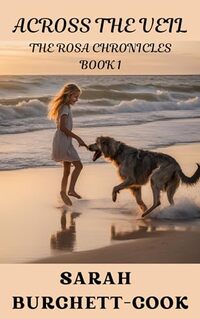
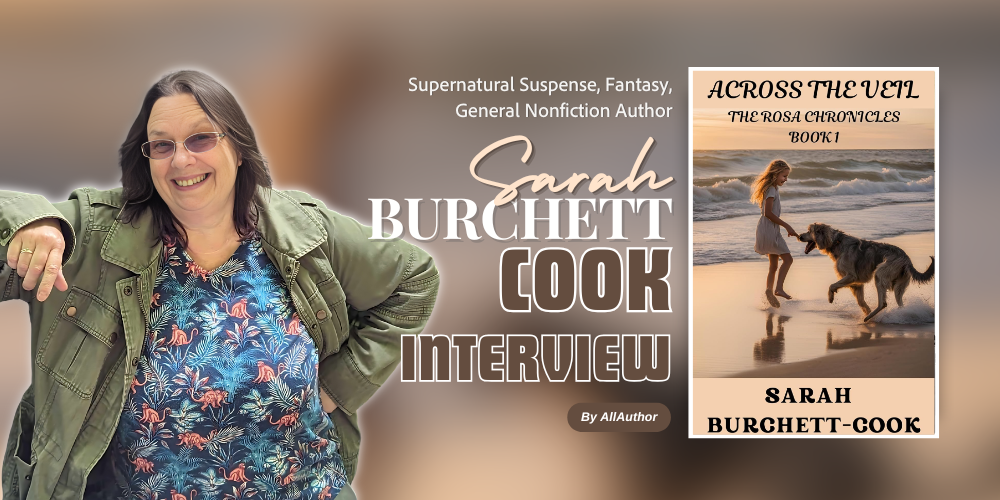
In “Across the Veil” Rosa straddles two worlds—how much of her experience mirrors your own as someone transitioning between genres or identities?
Even before leaving the university, Rosa’s story was bubbling around in my head, probably for about ten years or so. I never had the time to pursue it, but she was raring to get out! When I finally sat down to write the book, it poured out onto the page. It was actually the first fiction book to be written, even though it wasn’t the first to be published. Yes, I guess there is a degree of an analogy between Rosa’s world and my own. I hadn’t really considered that before.
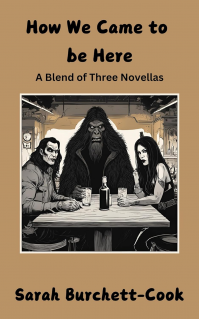
How did the idea for “How We Came To Be Here”—a vampire, a witch, and a sasquatch—first come to you?
It’s such a quirky and unexpected mix. I like quirky! But I’m actually putting together a collection of short stories. But when one of those ‘Grey Witch’ took on a life of it’s own, and grew into a novella-sized work, I thought well hey, why not a set of 3 novellas? As for the vampire, I enjoy vampire stories, but always wondered if this actually happened to someone, wouldn’t they be repulsed by it? So, enter ‘The Reluctant Vampire’. A sasquatch story had to be done. Sasquatch is my husband’s nickname. Having written one and got the ideas for the other two stories, it seemed natural to find a way to link them. This meant the sasquatch had to come to the UK where the other two characters were. So ‘Sasquatch on Holiday’ was born.
Many readers are intrigued by the idea of parallel worlds. What does the concept of the Veil mean to you beyond just a plot device?
The Veil feels like a thin, barely visible barrier. There had to be some kind of barrier, otherwise everyone would be popping from one world to the next and back again, but at the same time, it needed to be easily traversed by someone with the ability to make the crossing.
Scotland features prominently in your novels—what is it about the landscape or history that lends itself so well to fantasy?
Scotland’s past is steeped in mystery and legend. Much of the country is sparsely populated, wild and natural looking. The lochs and mountains generate mists that linger, and make place seem timeless. There are also ancient ruins everywhere. Not just the tourist traps, as you only have to go for a walk in the countryside to stumble on the remnants of a castle, a long forgotten wall covered in lichens or perhaps a cairn. It’s an inspirational land. Of course, I’ve written about Cornwall and Wales too. The 2nd Rosa book, not yet published, will go much further afield.
What were the earliest fantasy books that made a deep impact on you as a child or young adult?
As I mentioned earlier, Lord of the Rings caught my imagination. I also loved Mary Stewart’s ‘Crystal Cave’, all of Ann McCaffrey’s, Stephen Donaldson’s, David Eddings and David Gemmel’s books, and, going back further, I was hooked on fairy tales as a young child.
Do you feel fantasy offers a unique way to explore real-world issues such as prejudice, identity, or belonging—as you've done with Rosa?
I guess in some ways it may do that. You can’t really write about characters without including their struggles, but also the ‘wins’ they have in life. But really, it’s not my intention to preach. I hope my readers just enjoy the books.
How do you balance the whimsical or magical elements with emotional depthor grounded themes in your storytelling?
For me it’s all about a bit of escapism. However good life can be, sometimes you just want to ‘be’ in another place for a while.My characters are like ‘real’ people. They are just traversing a different world. Hopefully this makes them relatable.
Do you have a specific writing routine or ritual that helps you stay connected to your “magic” while writing?
No, not really. I often hear authors say that you should write something every day. That doesn’t work for me at all. I sometimes sit and write for hours, and for days at a time, then I may go for a week or two (or more) and write nothing. My head has to be in writing mode, otherwise nothing of value will end up on the page. I don’t force, it, I go with the flow, and then it just seems to work.
What is your favorite part of the writing process—worldbuilding, character development, or plotting? Why?
This, again, is about going with the flow. I love all parts of the writing process, but each of the elements you’ve mentioned come, for me, at different times.
Perhaps the world-building happens after a good hike, and the character development when I’m in an introspective frame of mind. I’m not sure where the plotting comes from, sometimes the plots just seems to write themselves. That makes no sense I know!
How do you keep your fictional worlds consistent and believable, especially when dealing with parallel realities?
Even my parallel worlds have a lot of realism to them. It makes the stories more of an edge of believability, despite all the magic, legendary beings and made-up worlds. In the ‘Elysia and Beyond’ series, Elysia is purely a creation. So I sketched a map to ensure distances and realms remained consistent throughout. For the ‘Rosa Chronicles’ series, both side of the Veil are the same geographically, but have evolved differently over the centuries, so there’s a strong connection between the two sides.
Can you give us a hint about what’s coming next? Any new worlds you’re dreaming into existence?
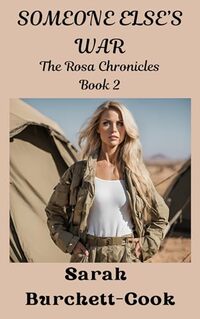
I had planned for ‘Elysian Dream’ and ‘The Book of Tamonah’ to just be a book and it’s sequel, but I’ve now decided that there is good scope for a third book to make it into a trilogy, so I’m working on that at the moment. Also, the 2ndbook in ‘The Rosa Chronicles’ is written and ready to, but I’m holding off asBook 3 has a long way to go yet and I want the releases to form a logical pattern. I will reveal that Book 2’s title will be ‘Someone Else’s War’. There’s alsothe short story collection in the making, but I’m in no hurry to complete that. I enjoy switching off my other work to write these too much to draw those to a conclusion any time soon.
How has been your experience with AllAuthor?
AllAuthor have been great. I’m bombarded daily on email and social media by marketeers and people promising the earth, if only I throw hundreds of dollars at them! AllAuthor charges are very reasonable for an excellent service. I love the mockups and enjoy putting my book into the cover contest, and also voting for covers for books in the other genres.