Genre:
Science Fiction- Country: United States
- Books: 4
- Profession: Author
- Member Since: Apr 2025
- Profile Views: 1,942
- Followers: 30
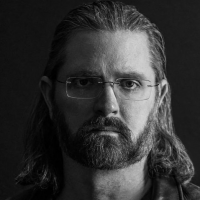
Seth W. James is the author of Ethos of Cain and The Cain Series of episodic, near-future, cyberpunk science-fiction novels. Growing up in New Jersey, Seth served in the United States Army Infantry, rising to the rank of sergeant before leaving to pursue his education, taking a degree in English and History from Rutgers College, Rutgers University; Seth has also worked in scientific publishing for more than twenty years. Though now exclusively a cyberpunk novelist, Seth’s backlist includes novels in several other genres. The full list of Seth W. James books can be found on SethWJames.com. Seth lives in Montclair, New Jersey.
Seth W. James's Books
Stay in the loop on books by Seth W. James. See upcoming and best-selling books by the author here. You'll also find the deals on books by Seth W. James.
** Please note that the information or price displayed here may not be the updated. Make sure to double-check the latest book price before buying books.
** Also, there might be other books by Seth W. James not listed on AllAuthor.
| Book |
|---|
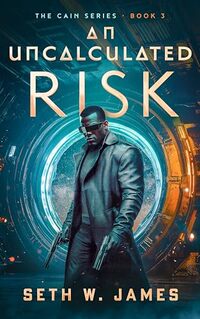 An Uncalculated Risk (The Cain Series Book 3)by Seth W. JamesPublish: Apr 30, 2025Series: The Cain SeriesScience Fiction |
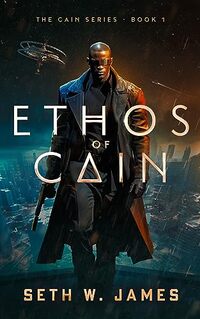 Ethos of Cain (The Cain Series Book 1)by Seth W. JamesPublish: Aug 31, 2023Series: The Cain SeriesScience Fiction |
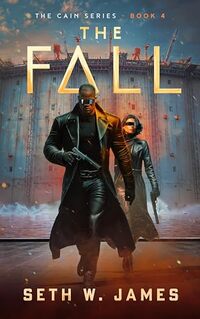 |
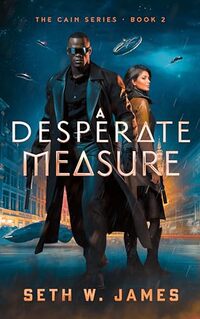 A Desperate Measure (The Cain Series Book 2)by Seth W. JamesPublish: May 31, 2024Series: The Cain SeriesScience Fiction |
Seth W. James Interview On 25, Aug 2025
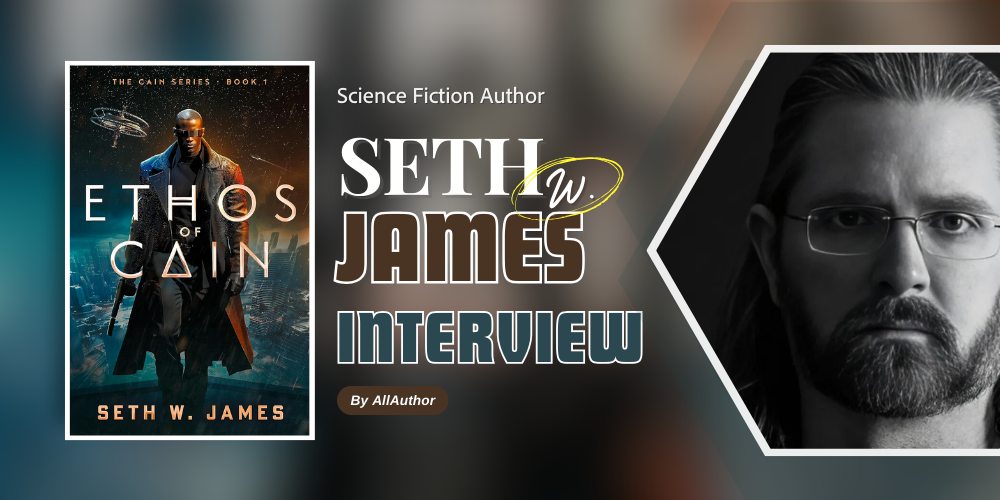 "Seth W. James, a New Jersey native and former U.S. Army sergeant, is the author of Ethos of Cain and The Cain Series, a gripping near-future cyberpunk saga. With degrees in English and history from Rutgers University and over twenty years in scientific publishing, Seth now writes exclusively in the cyberpunk genre. He lives in Montclair, New Jersey."
At the time of this interview, I’ve been writing novels for a little over twenty-five years: as for storytelling, though, that I’ve been doing since my earliest memory. So, it was never really a choice of writing or not; it was a choice of whether to devote the major portion of my life to writing—to developing the craft to a high degree—to the exclusion of other pursuits. That was the choice I made.
As for inspiration, all the best art is a matter of one artist being inspired by another. Certainly, in literature, if you look back to all the major writers, throughout every period, you will see the pattern of inspiration quite clearly: Virgil drew inspiration from Homer, Shakespear from Horace, Alexander Pope from Dryden; more contemporarily, Lord Dunsany inspired Tolkien, who also inspired H.P. Lovecraft, who inspired and was inspired by Robert E. Howard; Dashiell Hammett inspired Raymon Chandlier, who inspired a generation of hardboiled detective writers, like Robert B. Parker; and, in cyberpunk, John Shirley inspired William Gibson; and on and on.
One artist inspiring another is a microcosm of the human condition: one person learns from the labors of another and then explores some facet of that work, building upon it or driving out beyond the work, delving into the frontier that it had uncovered. And, also, a literary work is most successful when it not only tells a good story, but when it inspires its readers to imagine the story that was not told, which develops in the mind of the reader afterward. Reading is an artistic act.
As for why cyberpunk is my subgenre of choice, it was always the goal. While novels of all types, all genres, have confronted the issues of the day (such as The Jungle by Upton Sinclair), cyberpunk looks at the issues facing readers today and on into the future: the original cyberpunk writers warned about fascism in the USA, the surveillance state, the dangers of AI, internet addictions, deepfakes (though they weren’t called that yet), and the transnational power of billionaires. Too bad they were not listened to more, back in the day.
And so, those are the stories that I write, as well, looking at today through the lens of tomorrow, extrapolating the issues that will confront humankind in the next century.
“How did your military experience in the U.S. Army Infantry shape your perspective as a storyteller?”Well, of course, as a former sergeant and Fire Team Leader, I underwent significant training in all things ground combat, which informs the action sequences in my books. Battles have structures, just as books do, and are rarely the free-for-alls that moviegoers so often see. As Robert B. Parker was so fond of saying in his Spencer series of hardboiled detective novels, knowing how makes all the difference. So, of course, I draw upon my infantry experience when designing and depicting battles.
Beyond the technical and tactical proficiency, the leadership training and experience, I gained in the army, the need to understand the totality of an operation—which is necessary at every level, from the general to the private, since you never know when a single stray round might elevate someone from a subordinate to a leader—has probably, at least at a subconscious level, informed my process. Some writers like to just sit down, a cup of coffee or a scotch at their elbow, and let their imaginations run riot over the page: others like to plan out their stories before ever touching the pen or keyboard. I’m the latter kind. As it happens, dramatic structure and operations orders (op-order) bear a striking resemblance to one another. I don’t know if that makes me a better writer than those who don’t plan—there are a great number of terrific writers who do not, after all—but it certainly makes me a faster writer.
“You hold degrees in English and History—how do those disciplines influence your approach to science fiction?”Some of the most important novels ever written have been science fiction: from Orwell’s 1984 to Bradbury’s Fahrenheit 451 to London’s The Iron Heel, science fiction asks, “If we continue in this direction, where does it take us?” Cyberpunk takes that question to the next level, focusing on the exploitation of innovation, inequality. So, again, as Robert B. Parker liked to say, knowing how makes all the difference. Literature does not exist in a vacuum, neither does history or journalism or public opinion or the zeitgeist as a whole: studying their inspiration of one another, how they have interacted throughout history, can help writers to anticipate how today will affect tomorrow.
“After working over two decades in scientific publishing, what finally pushed you to write fiction full-time?”Oh, I’d been writing fiction the whole time. I completed my first novel back in 2003, I think it was, got an agent for it, had high hopes—and then he couldn’t get it sold. Oh well. It would be another decade or so before it finally sunk in that the traditional publishing world does not want to publish the kinds of books that I write.
Like most writers I know, whether trad-published or independent novelists, I still work a full-time job in addition to writing full time. Who needs sleep? I do find that food and a roof over my head are a big help to focusing on writing novels, though, and so I’ve continued to work full-time in scientific publishing, too. I think the public-at-large often overestimates how much money is involved with publishing novels: it ain’t much. Unless you’re selling movie rights, you have a day job.
“Your writing spans several genres. What led you to settle exclusively into cyberpunk?”I had originally set out to write cyberpunk, with a few abortive attempts as early as middle school. The thing about cyberpunk, however, is that it is one of the most complicated and difficult subgenres in which to write. Cyberpunk stories often involve elements found not only in trad-sci-fi, but in techno-thrillers, hardboiled-detective fiction, political thrillers, crime noir, military fiction, weird fiction, and even historical fiction, and so to write the best possible cyberpunk, the cyberpunk novelist needs to develop skills in these other subgenres.
After leaving the army, I decided that the time was right, this was the day to sit down and pound out the next great cyberpunk masterpiece—and quickly discovered just how in over my head I was. I enrolled in college the next day.
I also began, at that time, to write novels that, instead of trying to incorporate all of the elements found in cyberpunk, focused on a single element that I might later employ in a cyberpunk novel. So, for instance, I wrote a couple of (unpublished) crime novels; ex-soldiers pulling down scores, hunting bounties, that sort of thing; both of them helped me to develop skills in writing crime and action sequences, which are so often core components to a cyberpunk novel. I would go on to write two political thrillers, during the second Bush administration, castigating their illegal actions, which taught me skills in suspense, plot development, and the careful rollout of needed facts. I would go on to write literary fiction, a Cthulhu detective novel, a crime anthology, and even a fantasy novel (which helped me with employing a large cast of characters), all of which led to my developing the skills I would need for cyberpunk.
I would like to think that those novels tell good stories, are worth readers’ time, and are enjoyable in their own right, but they were also a journey, my journey, toward acquiring the breadth of experience needed for the ultimate challenge of writing cyberpunk.
“Can you introduce Ethos of Cain to readers new to your work? What makes this series unique within the cyberpunk landscape?”The Cain Series is cyberpunk in the classic mode: near-future (cyberpunk has often been describe as “five-minutes into the future”); high-tech low-life (a term, I believe, coined by Bruce Sterling, who also gave the subgenre its name, drawing from the title of a Bruce Bethke short story of the same title), which means, essentially, criminals or lowlifes employing the highest of high-tech; and explores how any innovation, regardless of its real or intended benefits, will be exploited by the powerful—be they billionaires, governments, or criminals—to take advantage of all the rest of us.
In The Cain Series, I look at how the next technological revolution (specifically fusion power and a new form of propulsion called CasiDrive) will be exploited by the powerful, as well as the worsening crises of climate change and inequality. So, for example, we see how the explosion in space-based commerce has led to orbiting space stations—referred to simply as orbitals—declaring themselves sovereign, distinct from Earth governments and not subject to Earth laws.
Readers who have enjoyed the works of John Shirley, William Gibson, Pat Cadigan, Bruce Sterling, Melissa Scott, Rudy Rucker, Walter Jon Williams, and others from cyberpunk’s original roster will find similar themes and stories in The Cain Series (as well as several literary allusions to their works). Just as technology and society have progressed (or regressed, in some areas), however, cyberpunk must also adapt to how the world has changed and so, while many of the innovations explored by the original cyberpunk writers are now commonplace, today (each of us walking around with a powerful computer in our pockets, billionaires holding power over countries, the world conducting its affairs all but entirely online), the next great exploitations are likely to be found in orbit, on the moon, and, eventually, Mars—and these exploitations will have enormous impacts for everyone living on Earth. It’s these new stories, this new future, that The Cain Series explores.
“The Cain Series is described as episodic—what does that structure allow you to explore that a traditional novel might not?”That is a very big question, one that is probably better answered in a blog post I wrote for sethwjames.com: https://www.sethwjames.com/stories-within-stories-the-episodic-form-and-novel-cycles-in-the-cain-series/
Suffice it to say that, in The Cain Series, I have employed the episodic form coupled to classic dramatic structure, which is a fancy way of saying that each part or episode in each novel—which tells a discrete, or self-contained, story, with its own conclusion—also contributes to the novel’s overall story, just as the individual acts in a classically structured drama might. So, just as in a five-act play, act one introduces us to the characters, act two to the world, and we can expect some sort of complication around acts three or four, so, too, in Cain Series novels, we can expect part one to—in addition to telling its own story—introduce us to the characters whom we will need to know for the rest of the novel; we will also expect to see some sort of complication arise in part three or four; and so on and so forth.
Now, do readers need to know how all that works? No, not really. It’s just how the machine works: you don’t need to know how a car’s engine works in order to drive it, after all.
The ultimate effects of telling stories this way, however, are many and greatly beneficial: the Cain Series novels are all lightning fast paced, action-packed (as each part has its own obstacle to overcome, its own strife to quell), and—by breaking down complicated storylines into multiple parts—explore today’s most important issues without badgering the readers with endless exposition, instead conveying needed information in small portions, just enough to move each part forward.
Beyond how each novel works—by combining its parts or episodes to tell a larger story—the novels combine into groups or cycles to tell larger stories, too. So, books one through five, for instance, constitute the first cycle of novels, telling—in addition to their individual stories—the story of how Cain and Francesca Pieralisi met and came to work together; it also tells the story of how both of them changed, through the course of the first five novels, and became the people who would then strive forth into the rest of the series.
“What central themes run through The Cain Series, and what message do you hope readers take away?”Like all real cyberpunk, The Cain Series explores the innovations of the near-future, of the fusion revolution, and how they will be exploited by the powerful to take advantage of the rest of us. To that end, we see how the lingering effects of climate change—particularly rising sea levels and worsening food-scarcity—will affect the global economy, migration, public policy, and war; and these macro-level events will impact every character at every level, so even store clerks and refugees will feel the effects of the exploitations of billionaires.
On a more personal, character level, we see the difficulties that Cain and Francesca face from having come from two very different worlds: where Cain came up on the streets of Brooklyn, graduating from street crime to the ranks of international soldiers of fortune, Francesca was raised and educated as a part of the Italian elite, serving first as a prosecutor and later as the Mayor of Venice. Their different perspectives and approaches sometimes lead to conflict, but their core values and inner strength unite them, as does their love for one another, and they find a way forward.
As for the stories themselves, we often see Cain, early in the series, pulling down scores for criminals, corporations, and governments, frequently on his own, though sometimes while leading crews. His role then changes, when he becomes Chief of Security for Francesca, when she takes a job with the European Commission: his work, in turns out, does not change, as he faces the same sorts of adversaries while protecting Francesca. On her side, she is often stymied by her adversaries existing beyond the law (billionaires, sovereign corporations) and is often lured to Cain’s shady side of the street, to complete the projects she holds dear by any means necessary, to further the public good.
“What were the biggest world-building challenges you faced when creating your near-future setting?”Anticipating how the world will change is easily the most difficult part. For example, if I mention the existence of Taiwan in a novel, I would be taking for granted that China does not conquer the island nation, at some point. Given the worsening rhetoric around Taiwan, from the PRC, it’s a dicey bet. There are loads of other scenarios like that, such as whether truly sapient AIs will ever exist (I have my doubts), whether centrifugally induced artificial-gravity is endurable or will cause unbearable inner-ear pain (fundamental to giant, spinning space stations), or how persistent the effects of climate change will prove, if humanity should ever develop clean, reliable fusion power. Any one of those things goes the other way from how I anticipate them, and my novels will seem a bit odd, in a couple decades.
“Do you see any parallels between the world of Cain and our current technological or political trajectory?”Of course. All good science fiction—and particularly cyberpunk—comments on today by looking at tomorrow. True cyberpunk is a sort of melding of fiction and journalism: instead of a contemporary techno- or political thriller’s immediate exploration of a given topic, though, cyberpunk extrapolates what the topic’s ultimate effects will be. For the cyberpunk writer, every new, great, shinny innovation comes with a warning about how it will be exploited by the powerful.
“What does your typical writing process look like—from concept to final draft?”I should first say, specifically to early-career writers, that all writing advice—particularly if found on the internet—is crap. Don’t listen to advice. What works for one writer does not work for another: your goal, as an early-career writer, is to find out what works for you. There’s a great quote from Matsuo Bashō, it’s something like: “seek not to become like the ancient masters; seek what they sought.” Your job isn’t to become Hemingway (just think of the whiskey bills!): your job is to become you-as-a-good-writer.
That being said, my process for The Cain Series involves a lot of notes. So many notes. I begin at the novel cycle level, deciding what story the next group of novels will tell and then determine what components I’ll need to tell that story: what characters, technology, events, extended metaphors, knowledge to convey to readers, etc. If I need to research, I do so at this point (and later on, as needed). I then map out that multi-novel cycle at a high level, as a kind of timeline: what has to happen and in what order to tell the story. I then assign elements to the individual novels in the cycle, based upon when they take place in the timeline and whether I’m using a three-act or five-act structure.
I then write high-level notes for each novel, first determining what stories each will tell and how they’ll tell them; same process as for the cycle, but focused on each novel in the cycle. Each novel then gets a timeline.
I then move on to the first novel. Building off of the timeline, I break the story down into its component parts or episodes, each corresponding to the act structure that will tell the novel’s story. I’ll then write notes for each part, to ensure that they all properly contribute to the novel’s story.
I then move on to the first part or episode in the novel. Just like at the novel-cycle and novel levels, I plot the part and begin with its timeline. I then move on to its act structure, its subplots (looking back to how they’ll interact within the novel and novel cycles), character development (again for the part, book, and cycle), and any additional notes I’ll need.
I then write the “specific notes,” as I call them, which are the scene-by-scene notes that comprise the part’s acts. The specific notes can, at times, become so granular as to constitute a rough draft, which is fine: this happens most often in dialogue and least often in action sequences. Once I finish the specific notes for a part, I move on to actually sitting down and writing the part. The benefit here is that, by the time I actually do sit down to write, I know the story inside and out and can focus entirely on the quality of the prose, at the sentence and paragraph levels, rather than trying to juggle that or save it for later, while also trying to structure the story, simultaneously. Again, this technique may not work for every writer (in fact, I’d be surprised if it works for many, at all): I know many writers who hate revising and editing specifically because, by that point, they know their stories too well and have become bored with them.
After I write a part or episode, I read and revise it as necessary. I then move on to writing the specific notes for the next part or episode, followed by writing it, then reading and editing it, and then on to writing the specific notes for the next part.
After completing the whole novel, I’ll read it through immediately, editing as I go, and then take some time away from it, usually a few weeks, during which I’ll begin the timeline for the next book or cycle. Taking time away from a novel is good, I’ve found, to clear my mind of what it is “supposed to say,” so when I come back to it, I’ll read it with fresh eyes.
After reading the book through and editing it three or four times, it goes to the proofreader. I then go through it again, with the proofreader’s notes. I then send the text along with some guidance to the cover-design company I use (Damonza); they typeset the book and create the cover. I go through all of the publishing assets, next, to include the typeset proof, the cover, banners for advertising, publicity assets, etc. And then, finally, after all of that, I push the magic button online and the book is published.
Of course, at this point, I am also probably two parts into my next novel, so there’s excitement, yes, but mostly I’m thinking about the next novel. And the next.
“With your background in scientific publishing, how does your understanding of real-world science impact your speculative fiction?”I’ve enjoyed the great privilege to work, as a Managing Editor in scientific-journals’ peer review, with experts in the fields of ecology, evolution, conservation, and climatology (as well as many other areas). While I am absolutely not a scientist—let’s be clear on that point, haha—I did have the opportunity to pester real scientists with questions about these subjects and talk at length with them, for years and years. I consider that period to have been one of the richest experiences in my life and to have deeply informed my understanding of climate change and the increasingly dire consequences it will have upon all humanity. The Earth is literally losing its ability to sustain human life—and far too little is being done about it.
I should say that, in The Cain Series, climate change and inequality are central themes and underpin the plots throughout the series—but I don’t climb up on a big ol’ soap box and preach at the reader. Nobody wants that. Basically, if a novelist climbs up on the soapbox, it will generate a negative reaction with all three of the basic types of readers: people who agree with you will be bored by it and there’s no hope to accomplish anything with such a diatribe, since they already agree; people who disagree with you will continue to do so, because, conservatives in particular, cannot be swayed from their beliefs with facts or arguments, they only hold on tighter; and people who don’t know or don’t care will either be offended that you tricked them into hearing a lecture (they came for a story, after all, not a sermon) or feel embarrassed by their ignorance and, likely, react by siding with the people who disagree. So, no matter what, the soapbox is a bad idea.
There’s a time and place for the soapbox, absolutely, but it’s really the purview of the politician or essayist, rather than the novelist. For the novelist, I think it is better to tell a story that confronts these important issues and shows the effects: then the reader can decide for themselves and use the work as a reference point, a place to start their deliberations.
“What advice would you give to aspiring authors looking to write in the cyberpunk or science fiction genres?”Don’t. I know that sounds dire, but if there is any other way that you can find happiness, satisfaction, or artistic expression, do that. The public still retains this fantasy that writing novels will lead to fame, fortune, and prestige: it doesn’t. There’s almost no money it, particularly given the huge investment of time and effort; there are hundreds of thousands of other novelists, all trying to find readers, which makes life very difficult for readers, it should be said; and as for impacting the national debates on important subjects, good luck. The Reagan administration deregulated the communication industry for one specific reason: to destroy public dialogue and replace it with propaganda and political warfare. And they succeeded. The days of the big five (now four) curating important novels that might not sell a lot of copies but would impact the public debate on certain issues, is long since passed. The big four belong to the corporations, now, and their only concern is profit. It’s sparkly vampires and wizard schools from here on out.
If that diatribe (it’s okay because this isn’t a novel) didn’t scare you away, then I’d say start with the original cyberpunk novels. r/cyberpunk on reddit has a good wiki with lists of novels, movies, and other media. That can be a good place to start looking for recommendations. If I may be allowed to plug my website a second time, if you’d like to understand what cyberpunk actually is, you can check out this post: https://www.sethwjames.com/what-is-cyberpunk/. Just be aware that no two cyberpunk authors are likely to entirely agree on what cyberpunk is: the most often phrase seen in any discussion of the subgenre is, “That’s not cyberpunk!”
“What’s next for The Cain Series—and are there any other projects readers should look out for?”Book 4 of The Cain Series should come out by the end of 2025; it’s written and is, at the time of this interview, with the proofreader, so there are a few steps left prior to publication. I’ve already begun work on book 5 and hope to have it out by late spring or early summer, 2026. I’ll likely take the rest of 2026 to work out the cycle-level timeline and novel timelines for cycle two, which will comprise books 6 through 8, with book 6 hopefully coming out late spring or early summer 2027. My expectation at this point is, for however many years I got left, readers will get a Cain novel or two each year.
Other projects? Not anything imminent. I may eventually move to a one-Cain, one-not-Cain book per year cycle, but we’ll see.
“Would you recommend AllAuthor to fellow authors, and if so, what services or tools on the platform have you found most useful in growing your business?”I would. AllAuthor has an automated way of generating advertising assets, essentially pictures with your book in various scenarios, like someone reading it on a beach. These can be helpful on your blog, in your advertising, and in social media. We’ll see how this interview goes, too, in reaching new readers, haha. There are likely other services that I have yet to explore, too.
Ask Seth W. James a Question
Have brimming questions to ask author Seth W. James? Ask whatever you like, but keep it appropriate.
** Please note that unanswered questions will not appear on the page. Refrain from posting promotional messages.
Contact Seth W. James
The author, a good book and you! Contact Seth W. James here.
** Please refrain from spamming and don’t bombard the author with promotional mails/messages. Your IP/Email address may be blocked if found doing so.
Contact Author on: