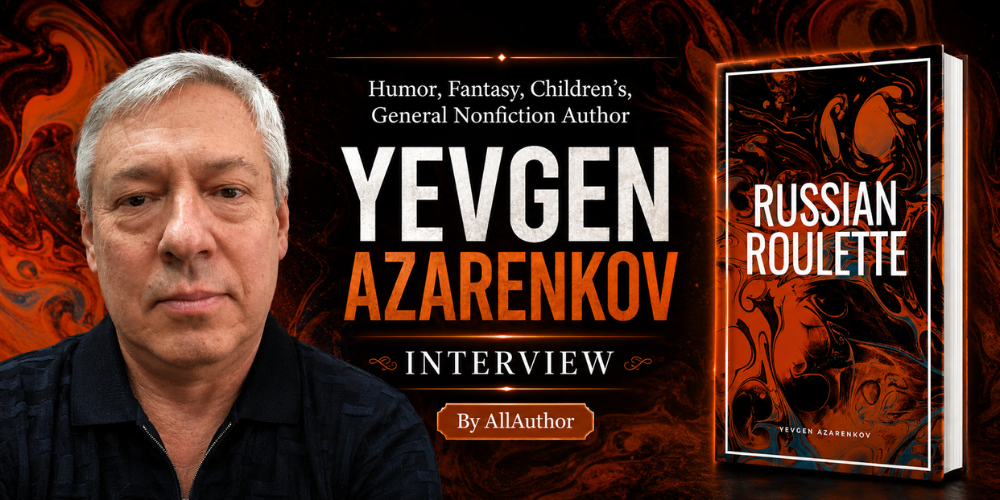
Yevgen Azarenkov Interview Published on: 24, Jul 2026
 Your books explore identity, power, and human behavior in very different ways. What draws you to these themes across such contrasting genres?
People are often surprised that I write in two completely different genres: children's adventure fiction and dark political satire. To me, however, they both begin with exactly the same question: Why do people behave the way they do?
Alongside fiction, I also write occasional documentary-style reflections on current events. They are not meant to be historical records. History is written by many people. What interests me is the human response to history—the fears, ambitions, hopes, and moral choices that emerge when ordinary lives collide with extraordinary events. I try to look beyond the headlines and understand the psychology behind them.
In recent years, that curiosity has inevitably been shaped by the Russian-Ukrainian war. Living through such a defining moment changes the way you see the world. It forces you to think not only about politics, but about courage, fear, loyalty, responsibility, and the remarkable resilience people discover when their lives are turned upside down.
My children's books came into being for a much simpler reason.
After retiring, I suddenly found myself with something I had rarely enjoyed during my working life—time. I began inventing adventure stories for my grandson, Dzhikoni, making him the hero of every tale. At first, I wasn't trying to write books. I simply wanted to entertain him while gently encouraging curiosity, courage, kindness, and perseverance. Every story was written for an audience of one.
Then one day my wife looked at the growing stack of manuscripts on my desk and smiled.
"You've spent your whole life in the wrong profession," she said. "You should have been writing books."
Looking back, I think she may have been right.
That conversation changed everything. It gave me the confidence to share my stories with other readers and to begin an entirely new chapter of my life.
How did your experience as a General Manager in a global high-tech company influence your approach to storytelling and character development?For most of my life, I was an engineer and later a business executive, managing the Ukrainian division of a global technology company. Becoming a writer was never part of my career plan.
December 31, 2021, was my final day at work. I believed I was entering the quietest chapter of my life.
Less than two months later, Russia launched its full-scale invasion of Ukraine.
Like millions of my fellow Ukrainians, I watched the future I had imagined disappear almost overnight. Plans that had seemed perfectly ordinary suddenly became irrelevant. Retirement turned into something entirely different from what I had expected.
Writing became my way of making sense of a world that no longer made sense.
It was never simply a hobby. It became a way of observing, reflecting, and preserving perspective at a time when uncertainty seemed to dominate everyday life.
Looking back, I realize that my years in engineering and management prepared me for writing in ways I never anticipated. Leadership teaches you to observe people carefully, to recognize motivations hidden behind decisions, and to understand how authority changes human behavior. Those same skills are surprisingly useful when creating fictional characters.
Sometimes I joke that I had two careers.
The first taught me how organizations work.
The second allows me to explore how people work.
What inspired the concept behind Russian Roulette and its exploration of power through surreal and grotesque situations?People often ask why I write political satire.
The answer is simple: during my lifetime I have watched history change direction more than once.
Like many Ukrainians of my generation, I have deep personal connections with Russia. I graduated from university in Moscow, worked briefly at the Academy of Sciences, and met my future wife there before we moved to Ukraine.
At that time we all belonged to one country. By the end of the Soviet era, however, that system had exhausted itself—economically, politically, and morally. When the Soviet Union collapsed, Ukraine and Russia set out on separate paths.
Those paths were different, but they also shared familiar problems. Corruption flourished. Institutions were fragile. Wealth often found its way into the hands of the most ambitious rather than the most deserving. Having spent many years in business, I witnessed these changes firsthand rather than reading about them afterward.
Over time, however, the two countries evolved in very different directions.
Ukraine's progress has never been easy. We have experienced political crises, economic hardship, revolutions, and now war. Yet despite everything, Ukrainians have continued insisting on one fundamental principle: governments must remain accountable to their citizens.
Russia followed another path. Political power gradually became concentrated in the hands of former security service elites, democratic freedoms steadily diminished, and authoritarian rule became the defining feature of the state.
Living through these transformations naturally influenced my writing.
Russian Roulette is not political journalism. It is satire.
Satire allows reality to be pushed just far enough that truths hidden beneath official speeches and carefully constructed public images suddenly become visible. Sometimes exaggeration reveals character more clearly than realism ever could.
That is why I place recognizable political figures in surreal and often absurd situations. Once power, ceremony, and public relations disappear, only the individual remains.
And that is the person who truly interests me.
In Russian Roulette, powerful figures lose control over their circumstances. What message were you hoping readers would take away from that loss of control?Power often creates the illusion that certain people are beyond consequences.
History suggests otherwise.
Most of the central characters in Russian Roulette abuse authority, manipulate others, or become entangled in corruption and crime. In real life, such people often appear untouchable. Fiction gives me the freedom to ask a simple question:
What happens when they lose everything that once protected them?
By removing them from the political stage and placing them on an isolated island, I strip away their titles, influence, wealth, security, and carefully managed public images.
Only the individual remains.
That is where the real story begins.
Without power, people reveal themselves very quickly. Some continue trying to dominate everyone around them. Others fall apart. A few are forced to confront themselves for the first time in their lives.
Whether they succeed is another matter.
At its heart, Russian Roulette is not really about politics. It is about accountability.
Power can protect people for a while.
It cannot protect them forever.
That is something I still believe.
Your work often asks what happens when someone is placed in a situation they were never meant for. Why does that question fascinate you so deeply?There is an old saying: "Man proposes, but God disposes."
No matter how carefully we organize our lives, none of us knows what tomorrow will bring. Recent years have reminded us of that in the harshest possible way.
Extreme circumstances do not create character.
They reveal it.
Ambitious people continue seeking power. Violent people rarely abandon violence. Yet others discover courage, compassion, or resilience they never knew they possessed.
That mystery has always fascinated me.
In Russian Roulette, familiar political leaders suddenly lose everything that once defined them. Their surroundings change completely, but their personalities do not. Each responds according to his own nature.
Whether readers agree with my portrayals is almost beside the point.
Satire is not biography.
It is an exploration of human behavior through exaggeration.
If I hope readers take one idea away from the book, it is this:
Choose your leaders carefully.
The decisions made by a handful of people can shape the lives of millions.
History has reminded us of that more than once.
The New Adventures of Dzhikoni has a playful and imaginative tone that differs greatly from your political satire. How do you shift creatively between these two styles?The shift comes naturally because I always know who I am writing for.
When I write for children, politics disappears completely. My only goal is to spark their imagination. I want young readers to experience the excitement of discovering hidden places, solving mysteries, overcoming obstacles, and occasionally laughing out loud. Those are the kinds of stories I loved as a child, and they are still the stories I enjoy telling.
Political satire serves a different purpose.
Here, humor becomes a way of asking difficult questions. Grotesque situations, irony, and exaggeration allow me to examine ambition, vanity, corruption, and the strange behavior that often accompanies power. Sometimes laughter helps us see the truth more clearly than anger ever could.
Although the genres appear very different, I don't think of them as opposites. In both cases, I am writing about people. Whether my protagonist is a curious boy or a powerful politician, I am interested in what drives them, what they fear, and how they respond when life refuses to follow their plans.
In the end, I am exploring the same subject through two very different lenses.
What challenges come with writing both dark satire for adults and adventurous stories for younger readers?The biggest challenge is remembering that children and adults read for different reasons.
When I was writing Dzhikoni's adventures, I always imagined my grandson reading the next chapter. Every story placed him in difficult or unusual situations, but I never wanted danger to overshadow hope. No matter how serious the challenge became, my young heroes found a way forward through intelligence, courage, friendship, and determination.
I wanted children to finish each story believing that problems can be solved, that kindness matters, and that bravery is often quieter than we imagine.
Writing for adults is different.
Adults already know that life is complicated. They don't need simple lessons. What they appreciate is the opportunity to look at familiar problems from an unexpected angle.
That is exactly what satire allows me to do.
If readers laugh first and then find themselves thinking a little more deeply about what made them laugh, I feel I have achieved what I set out to do.
Dzhikoni's adventures turn ordinary life into something extraordinary. Did your own childhood imagination influence the story?Without question.
As a child, I was fascinated by adventure. Every forest seemed to hide a secret. Every abandoned building promised a mystery. Every journey, no matter how ordinary, felt like the beginning of an expedition.
Growing older changes many things, but I don't believe we should lose that sense of wonder.
My professional life eventually took me into engineering, science, and international business rather than literature. Yet somewhere inside, that curious boy never completely disappeared.
When I began writing for my grandson, I simply invited him back.
Through Dzhikoni's adventures, I wanted young readers to believe that curiosity is a strength. The world is far more interesting than it first appears, and every challenge can become an opportunity to learn something new.
Perhaps that is the greatest gift adventure stories can offer a child—not escapism, but confidence in exploring the unknown.
Satire can sometimes reveal uncomfortable truths about society. Do you see your writing as social commentary, entertainment, or a blend of both?For me, the two cannot really be separated.
Entertainment without substance is quickly forgotten.
Social commentary without humor often becomes a lecture.
I try to find the point where those two meet.
Most of the central figures in my political fiction are deeply flawed. They are ambitious, vain, manipulative, or obsessed with power. Some readers mistakenly assume that because these characters occupy the center of the story, they are somehow its heroes.
They are not.
Satire works much like a caricature. By exaggerating certain features, it allows us to notice qualities that might otherwise remain hidden. The goal is not simply to make readers laugh at politicians, but to encourage them to think about the nature of power itself.
If someone closes one of my books smiling—and at the same time questioning something they had previously taken for granted—I consider that a successful piece of satire.
How do you balance humor, absurdity, and deeper philosophical questions in your storytelling?I have never believed that humor and philosophy belong on opposite sides of literature.
Life itself is often absurd.
History can be absurd.
Politics can certainly be absurd.
Ignoring that absurdity would make my stories less truthful rather than more.
Humor creates distance. It allows readers to laugh before asking themselves why the situation feels funny—or why it feels uncomfortably familiar.
That moment of reflection is where satire becomes something more than entertainment.
I never begin with a philosophical theory that I want to explain. I begin with people, place them in unusual circumstances, and watch how they respond. The larger questions emerge naturally from their choices.
If readers come away entertained, I am pleased.
If they also spend a little time reflecting on power, responsibility, freedom, or human nature, then the story has accomplished something even more meaningful.
Many of your characters are forced into unexpected realities. Do you believe people discover their true selves only under pressure?I'm not sure pressure changes people as much as it reveals them.
Most of us spend our lives in familiar surroundings, following routines that rarely test who we really are. We like to believe we know ourselves. Then life suddenly changes—through war, personal loss, or some other unexpected event—and we discover qualities we never knew we possessed.
Some people become remarkably courageous.
Others become generous.
Some reveal fear, selfishness, or cruelty.
The truth is that none of us can be completely certain how we would behave until circumstances put us to the test.
That uncertainty fascinates me as a writer because it is deeply human. It reminds us to be careful when judging others—and even more careful when judging ourselves.
What role does unpredictability play in your writing process and in the worlds you create?I have always preferred order to chaos.
My years as an engineer and business executive taught me to plan ahead, solve problems methodically, and think several steps in advance. That habit has never left me.
Life, however, has repeatedly shown me that it has little interest in our plans.
History can change overnight. A single decision, a single event, or a single day can send millions of lives in an entirely new direction. Ukrainians have experienced that reality more than once.
Perhaps that is why unpredictability plays such an important role in my fiction.
I don't create chaos for its own sake. Instead, I place my characters in situations they never expected and watch how they respond. Their decisions interest me far more than the circumstances themselves.
In that sense, every story becomes a small experiment in human nature.
Are there particular authors, philosophers, or life experiences that have had a strong influence on your work?People are sometimes surprised when I answer this question.
The truth is, I have never considered myself an especially well-read person. I often joke that I'm more of a writer than a reader.
When I was young, I admired Ernest Hemingway for the clarity and simplicity of his prose. Like many readers, I discovered many other wonderful authors over the years, but I cannot honestly say that any single writer shaped my own voice.
Life has been my greatest teacher.
Engineering, scientific research, international business, working with people from different cultures, witnessing the collapse of one country and the birth of another, and now living through war—those experiences have given me more material than I could ever have found in a library.
When I sit down to write, I rely less on literary tradition than on memory, observation, and experience.
Stories begin with people, and life has introduced me to many unforgettable ones.
With your ability to move between political satire and imaginative adventure, what kinds of stories are you most excited to explore next?The answer depends on which side of my imagination happens to wake up first.
Children's adventures usually begin with a simple question:
"Where could Dzhikoni go next?"
From there, the story develops naturally. I enjoy creating new mysteries, unusual places, and unexpected challenges that encourage young readers to stay curious about the world.
Political satire works very differently.
The modern world constantly presents situations that are so extraordinary they almost seem fictional already. I simply watch what is happening and sooner or later find myself asking,
"What if reality took one more absurd step?"
That question has started many of my stories.
As long as people continue surprising me—and I suspect they always will—I doubt I will ever run out of ideas.
For me, writing is less about choosing a genre than about remaining curious.
How would you rate your experience of working with AllAuthor?It has been a genuinely rewarding experience.
As someone who came to writing later in life, I appreciate every opportunity to introduce my books to readers beyond my own country. Literature has always crossed borders more easily than politics, and platforms like AllAuthor help make those connections possible.
I have also enjoyed being part of a community where books, rather than algorithms or headlines, remain the center of attention. That matters to any writer.
If there is one lesson my own journey has taught me, it is that it is never too late to begin a new chapter.
I spent decades solving technical problems, managing people, and building a career in engineering and international business. Only after retirement did I discover that stories had been quietly waiting for me all along.
Whether I write about a boy searching for adventure or powerful people stripped of their power, I am really exploring the same mystery: human nature.
If readers finish one of my books with a smile, a question, or simply a new way of looking at the world, I feel I have succeeded.
That, to me, is the greatest reward any writer could hope for.