Alfred J Brenner Interview Published on: 09, Jun 2025
 What inspired you to join the Marine Corps, and how did you decide to become a K9 handler?
It was during the summer between my junior and senior year of high school when I needed to apply to colleges and make a decision that would seemingly dictate the rest of my academic and professional career. Without too much direction or idea of what I wanted to do, I decided it was best to travel, gain life experience, obtain educational benefits, and ultimately push myself even further. These factors ultimately led me into a recruiter's office to discuss job options after boot camp. The most attractive occupational specialty to me aligned with my interests and immense transferable experience when my service time was up. After boot camp, I attended basic combat training, then was shipped off to Military Police school. During this time, I was allowed to push those limits even further and volunteer for the Military Working Dog Handler position, an elite group within the law enforcement community.
Can you share some memorable experiences from your training at Military Working Dog School in Lackland AFB?The first sentence of my application essay mentions that I never had a dog growing up and, truthfully, didn’t even like them. The lure of the prestigious group led me to this decision. The first time I walked through the kennels at K9 school was my first shock of how dangerous yet exciting this job seemed to be. The thunderous roar of barking dogs and being surrounded by those types of working dogs made me feel this was the challenge I surely needed. Every day was a challenge learning about how emotions run down a leash and how magical it seemed that a dog’s nose could sense even the smallest amount of explosives.
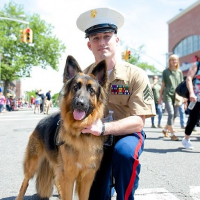
What was it like partnering with Grief for the first time? How did you build trust with him?The first time I met Grief, I was frustrated that he wouldn’t listen to me and seemed to be a stubborn, untrained dog. He’s driven to work, and his size made it difficult to handle him, primarily due to my lack of understanding and experience. The trust between a dog and its handler takes time and usually depends on each other’s personalities and work ethic. For us, it wasn’t until we were leashed together 24 hours a day in a combat zone that we fully trusted each other.
Can you describe the bond between a handler and their K9 partner in a combat zone?Some dog teams build that bond much sooner depending on their handling experience and the dog’s personality. In our case, although we understood each other’s quirks by the time we deployed, it wasn’t fully developed until we experienced hard times together. Whenever we pushed through intense experiences, our bond only intensified. They say hard times create hard men, and that’s much truer for a K9 team.
What were some of the challenges you and Grief faced during deployment?Initially, the challenges we faced were much like anyone else who deploys, like differences in environment like terrain, climate, and culture. However, one challenge that especially stood out for me was the number of stray dogs in the area. Of course, Grief’s presence antagonized them, and sometimes they would even try to attack. The second most traumatic challenge happened while trying to search for secondary explosives after a bomb went off and sent body parts and different odors all over, which was the hardest search.
Can you take us through the day of the explosion and how it changed your life?Of course, I do not want to take away from the story as the theme of the book surrounds the IED attack, but I will say that it was the best thing that ever happened to me. It started out just like any typical day and quickly transitioned to the worst day of our deployment. Several IEDs, being on top of one that killed another soldier, and losing my best friend who was right next to me to the very end. The whole day immediately changed the course of my life, and although great things have happened, the reality is that the war is never over.
How did you cope with both your physical recovery and the emotional loss of grief?If I had to weigh them side by side, getting better physically was much easier than emotionally. I was very motivated and driven to be as “normal as possible” and put the injuries behind me trying each day to let it not bring me down. Unfortunately, while you're distracted by trying to walk again, you don’t give yourself time to grieve what you have lost. It wasn’t until 2 weeks later that I first cried about him being gone. The best way for me to cope was simply to honor him by telling this story.
What was it like returning to the kennels one last time before retiring?Returning to the kennels felt as right as ever. Being able to spend time with my brothers I served with felt right at home and full circle. Although I couldn’t handle a dog anymore, my brain was still there. I wanted to try and pass along my experiences to the next group of handlers who would deploy in the next rotation. By setting up training and telling my stories, I felt I was able to do that before I hung up my leash for good.
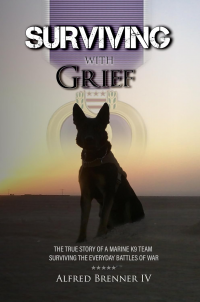
How did you find the inspiration to write your book, “Surviving with Grief”?During my rehabilitation process and therapy I was encouraged to write down my feelings or thoughts about that traumatic day in an effort to help process those emotions. As I was fortunate and blessed enough to remember the entire event I was able to recount most of those feelings and details. These therapy sessions along with other days of writing from my journal overseas allowed me to compile all of these stories and thoughts into what the book is known as today.
What advice would you give to fellow veterans struggling with loss and transition?Whenever I am fortunate enough to give a speech about my book or this topic, I always encourage veterans to reach out to anyone, especially those closest to them. The support of friends and families and surrounding yourself with those who love and care for you provides more help than we realize. I know it’s hard to reach out or even admit you feel like a failure or have problems, but that is the first step in overcoming any of it. And the most important thing to remember is that admitting and facing your struggles is the strongest action you can take, not the weakest.
What impact do you hope to leave with your book, “Survive with Grief”?My hope is that anyone who reads this book will have a better understanding of what young men and women, and specifically dogs, have to go through when they deploy to a combat environment. My goal is that the general public will have a better understanding of what sacrifices were made and how we can honor those who paid the ultimate price.
What message do you hope readers take away from your journey?The main takeaway and message I hope to project is what hope stands for to me. We love acronyms in the military, and to me, H.O.P.E. stands for Having an Optimistic Perspective on Everything. No matter how bad you think your situation is, someone will always have it much worse, and that helps us process those difficult feelings a little easier.
How has writing and speaking about your experiences helped in your healing process?Being able to share my story in a public setting has been very therapeutic for me. I am able to relive this experience and honor those who did not make it home by saying their names and telling their stories. It is also very healing for me to know that this may not all been for nothing. I may finally have a purpose if I am able to make an impact on my audience.
What do you hope to accomplish in the future with your advocacy work?My hope in the future is to advocate for those who may not have a voice. Whether that be to continually say the names who paid the ultimate sacrifice or for those who feel they are to weak to speak out for help. My hope is that those voices can be heard and they may receive the small push they need to be able to better themselves and effect more lives around them in a positive way.
What has your AllAuthor experience been like so far? What are some highlights?I have been pretty pleased with the platform so far. I like how they have there own system to promote books on their other social networks along with sharing insights and reviews across their our platform.