FH Spector Interview Published on: 19, Jun 2025
 What inspired you to start writing after leaving your teaching career?
I started writing the first book while I was still teaching. Due to circumstances out of my control, I had to set it aside once I’d left my position. I started working on it again after a difficult visit to my family in Cuba.
How has your experience as a National Board Certified Teacher influenced your writing, especially when it comes to connecting with readers?The National Board syllabus is a very structured, tedious, and rigid program. Honestly. No fun to write, and most definitely, no fun to read. I never wanted to write that way again, and I would never want one of my readers to endure that kind of writing.
Can you describe the transition from teaching gifted children to becoming an author? Was it an easy one for you?The transition was slow. I procrastinated over every direction the story would take. Teaching writing to 3rd-5th graders is not the same as writing a novel, and the process was challenging.
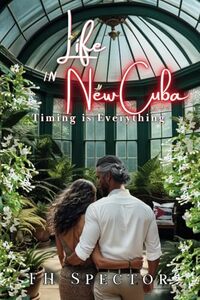
Carmen's life in New Cuba seems to be filled with excitement and danger. What inspired you to create such a dynamic setting for her story in “Life in New Cuba”?Some of the story elements were taken from stories I’d heard, then I built a world around those. The settings are places that I have walked many times on many visits. They are places I hold dear and close to my heart with very fond memories.
You mentioned a sabbatical to take care of family in 2015. How did that time away from teaching shape your perspective on life and your writing?I’ve always known that life is short. But when something happens, right in front of you, it’s a wake up call. No one should wait to accomplish the things they want because they may never get another chance.
I loved teaching and I fully intended to return to teaching, but that was not possible. My new flexible schedule allowed me the opportunity to explore the possibility of continuing to get my ideas on paper.
What do you think makes Carmen such a compelling character, and how do you want readers to relate to her struggles and triumphs?Carmen is an ‘every woman.’ So much of what she’s gone through, and IS going through, is highly relatable to adult women of any age. Younger women might see her as a cautionary tale, or even a heroine that triumphed over difficult times, and poor choices. To all women, she a heroine who learned to conquer her internal struggles to become the woman she was always meant to be.
How do your passions outside of writing, like painting, crocheting, and caring for your orchid collection, influence your creativity as an author?Every orchid variety requires varying light, water, nourishments. Changing any one thing, changes the direction of growth. Learning the ins and outs of this (I’m truly an amateur), gives me the opportunity to try different things until something jives. With painting, choosing my theme and subject, is just the beginning. Getting the image on canvas so the pieces fit together is always a fun challenge.
No matter what I do, seeing everything come together after all my experimenting is how I view writing. Hopefully, with just the right change in direction(s) I can write something compelling and enjoyable to read.
How do you ensure that the historical and political elements of New Cuba are depicted authentically while keeping the story engaging and accessible for your readers?The political elements were obviously fictional. Cuba is not free, nor is it a U.S. state. The historical elements were personal to me, and based on direct information I learned from the people still there, living it, every day.
The Scorpion Organization poses a growing threat to New Cuba’s freedom. How do you explore the concept of freedom in the story “New Cuba,” and how does it impact the characters' actions and choices?After witnessing, first hand, the oppression and utter horrific conditions they are living in Cuba, I have the unique perspective of seeing what it’s like to live in a country like the U.S. compared to a country like Cuba.
In Cuba, I watched people bullied and coerced by their servicemen and police, and I know the reason they do it. And what’s worse, the fear that consumes the people of Cuba on a daily basis. I’ve watched as people avert their gaze to floor over hunched shoulders from the harsh and unjust treatment that surrounds them.
The characters' moved from our great country to a post-communist Cuba (now a U.S. state), but have to deal with this Scorpion Organization trying to get Cuba back to it’s communist-socialist agenda. A place where they feel superior. The characters' know how high the stakes are if the S.O. gains any ground.
The concept of signs plays a significant role in Carmen’s journey. How do you explore the theme of signs and destiny in the story, especially in relation to Carmen’s feelings of being “past her prime”?Carmen clings to her concept of seeing signs, more in a way of stop herself from making the same mistakes over and over. She thinks if she sees the signs this time around, she can avoid her previous pitfalls. She realizes that in every past event, there were signs of what was to come. She blames herself for not recognizing the signs when they were right in front of her, so she begins to look for signs where there weren’t any as an excuse to ‘move on’ and not take any chances.
Coupled with her ex-husband’s abuse, Carmen also used her failures as a sign that it was too late and she was ‘past her prime.’
What’s the most challenging part of balancing your hobbies and passions with your writing?I’ve come to realize that I have set limits when I start any project, or the project takes over and I can’t get back to writing. I’ve started setting timers to limit the amount of time I spend on any one thing. The only thing I don’t set a timer for is writing. I really enjoy writing and I hope that feeling comes through in my work. This new story I’m working on is quite a departure from the first three books.
If you could teach one thing to aspiring authors based on your journey, what would it be?Love what you read, love what you write, do it for yourself and don’t worry about book sales. You will find your voice, and the books will find their audience.
You’ve had a rich career in education. Do you find that teaching principles, like empathy and communication, carry over into how you craft characters or narratives in your books?Absolutely. I’ve had an incredible a range of students. I didn’t always teach gifted students (which come with their own challenges). I might write a book about that one day.
I’ve had students with every kind of disability you can think of; physical, mental, and emotional. The emotional disabilities are the most difficult, you can’t see those. Teachers aren’t psychologists. All we can do is provide a safe and empathic space for those kids and allow them to feel their feelings.
What are your favorite topics to explore in your writing, and how do they tie into your personal values and experiences?There are so many topics. I guess it depends on my mood. After some recent ‘comedy of errors’ in our neighborhood, I thought about a comical series about neighbors in a cul-de-sac. Conversely, I love the supernatural and I thought of writing something along those lines. I have a lot of varying life experiences that would all lend well to many themes and topics.
How helpful did you find the tools and services offered by AllAuthor?I’m very new to book advertising and know little to nothing. AllAuthor is the only one I’m currently using for help in that arena. I’ve used the mock up banners and gifs.