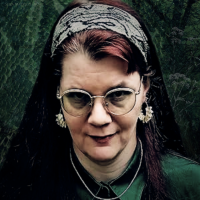
Sera Maddox Drake Interview Published on: 12, Jun 2026
 Your debut novel, Ancilla, blends neurodivergence, queerness, kink, and mysticism—what inspired you to explore such a unique intersection of themes?
I had a love story that asked to be told, so I told it.
I didn't deliberately set out to make my characters neurodivergent, but as an autistic person, I find it hard to get into the heads of neurotypical characters, and since the protagonist of Ancilla narrates the story from her own perspective and the reader is meant to be completely immersed and live in her perspective for the duration of her retelling of events, it should be assumed that she is as autistic as the author that created her. It should also be assumed that her primary love interest is also on the spectrum. They're counterparts to each other, after all, and they have a mutual understanding of communication that would, I feel, be more difficult if one of them were on the autistic spectrum and the other was neurotypical.
Autistic people need better representation everywhere, but especially in stories that have a strong erotic component. There seems to be a general perception that we are all asexual Sheldon Coopers if we even understand interpersonal relationships at all. Nothing could be further from the truth. My husband and I have four children (he's another autistic, by the way) and we have been married for nearly twenty-four years now. I think we understand what sex is and how it works.
Kink needs better representation, too. When I started work on the rough draft, it was 2013. The Fifty Shades franchise was at the height of its popularity. While those of us who are not vanilla are grateful to E L James for bringing what used to be deeply taboo out into the open and starting a conversation about it, the way we were depicted in the books and in the movies was not positive. The dominant was represented as being made into a sadist and a dominant by his having experienced abuse throughout his childhood, and his tendencies were therefore treated not as a hard-wired (and neutral) sexual orientation, but as a trauma response. The way he went about enacting his desires also tended to fall into the realm of unsafe action and dubious consent, which might make sense if he was using BDSM as an unhealthy coping method for dealing with childhood trauma, but it's not a good representation of BDSM as a whole. Since the Fifty Shades series was being represented as "this is what is normal in BDSM," I wanted to set the record straight.
Autism and kink are not inherently tied - if you drew a Venn diagram showing where autism and kink intersect, the end result would not look like a circle - but there is considerable overlap. A lot of us question heteronormativity because we don't feel like we fit in anywhere, so why even try? Furthermore, within the BDSM subculture, there is a lot for autistic people to call home. Open, clear negotiation rather than "guess/read my mind about something that should be a tacit understanding" is useful for us. We're often literal-minded; we're also not always good at implicit social understanding. It helps to be able to talk things out. Then there's stimming. Autistic people tend to have an atypical way of processing sensory input. Impact play and other creative forms of foreplay to lovemaking (or used as forms of lovemaking - why should lovemaking be limited to certain prescribed forms of genitally-focused intimacy?) are attractive as forms of stimming, for some of us. These are just some examples.
The autistic community has a name for the intersection of neurodivergence and non-heteronormativity, our basically not being wired for "normal." We call it being neuroqueer.
The mysticism is just there because it wanted to be there. "Magister" and "ancilla" are spiritual seekers, and they grope, often blindly, for enlightenment. "ancilla" has a background of religious trauma that she's trying to cope with. "Magister," meanwhile, has his own complicated backstory, a backstory that doesn't work its way into the narrative of Ancilla, although I intend on writing more stories about him. Conventional religion is not for them. They therefore aren't just taking a road less travelled; they're trying to create that road. That's how they experience the need for divine union.
Many readers say they struggle to categorize Ancilla. Do you intentionally resist traditional genre boundaries when writing?It's not that I resist genre boundaries when I write. It's that I don't even think about genre boundaries. I don't write with an audience in mind, nor do I write for any markets. I have a story, I tell it, and then, once it's been written, and after I've edited it about a gazillion times, I try to figure out how to classify and position it. I'm a publicist's migraine.
I suppose if I had to pick a genre to describe what I write, it would be literary fiction - erotic, visionary, magical realism literary fiction - but I do not like to be pigeonholed. I am not good at staying in a literary lane. My natural tendency is to weave all over the literary road, then roll onto the sidewalk and scare pedestrians.
How does your understanding of neurodivergence shape the characters and perspectives in your stories?I am autistic. I write about other autistic people. The characters I write are shaped by my own feelings and experiences, and by the feelings and experiences of my friends in the autistic community. One year I may attempt to write a story about a neurotypical character and tell the events of that story from their perspective, but I'm not there right now. It seems an interesting challenge, but I'd rather focus on other aspects of my craft, such as style and structure. Also, there are plenty of neurotypical characters and neurotypical authors already. There's not much material written by and for autistic people, or even written for neurotypical people who might be curious about the autistic perspective.
Your work is described as both deeply sensual and emotionally intense—how do you balance vulnerability with erotic expression?I don't know how not to write about the erotic in a way that is emotional. I write about lovemaking, not copulation.
What role does the occult or esoteric symbolism play in your storytelling process?I structured Ancilla on the sephiroth of the Tree of Life, working in order from Malkuth to Kether (which can either be seen as working up the tree or down, depending on your perspective - the Tree of Life has its roots in Heaven. Given that the Kabbalah is about union with God and attaining divine wisdom, I'd guess that the geometry involved is non-Euclidean, anyway).
Each chapter is themed on a sephira. I meditated and prayed before writing each chapter. Each chapter is meant to reflect the sephira it's themed on.
Outlining Ancilla was therefore kind of like building something large with multiple kits of Tinker Toys, only more spiritual, if that makes any sense (I'm not sure it does...)
The sequels will be themed on other "roads not as often traveled" to God.
Soror Mystica, which will be written about "ancilla's" graduate studies, will be themed on alchemy, and the book's sections and chapters will be based on the stages of the alchemical process when an alchemist attempts to achieve the Philosopher's Stone during experimentation.
Adept, which will be focused on "ancilla's" later years, will have its chapters based on combinations of Tarot cards. It will also have its overarching structure be the Tibetan Book of the Dead, because death is going to play a large role in the third book in the Magnum Opus trilogy. The characters are growing older, after all. Also, Adept has a ghost romance as its subplot.
Were there any particular authors, philosophies, or spiritual traditions that influenced Ancilla?Ancilla is what you'd get if you took Sylvia Plath's The Bell Jar, made Esther Greenwood bisexual, grafted The Story of O into the plot, but then mutated all the erotic aspects so that they would be about enthusiastic, joyful consent and empowerment rather than degradation. And then made the narrator and her main love interest a modern-day stand-in for Heloise and Abelard, but nobody gets castrated in this, nor does anybody join a monastery or a convent. Abelard and Heloise were incredibly kinky, did you know that? You should read their letters to each other.
As an independent author, what challenges—and freedoms—have you encountered in self-publishing your work?What I love about being an indie: I can do everything my own way. I can make my own book covers and illustrations (I had no idea how much I'd love learning how to make digital collages until I finished Ancilla and had to come up with a cover, and promotional pictures for Instagram and Pinterest!) I can write at my own pace (which is, alas, glacial). I can write what I want, rather than what I'm told to write by some publishing house. I get to keep all my moral rights, which means I can publish my own work under my own imprint without worrying that names, titles, and plot might be changed prior to publication. It's all about control. I have creative control.
What I don't love: I have to do everything myself - buy my own formatting software, choose publishing platforms or an aggregator and keep them all straight, buy my own ISBNs, buy my own formatting software, buy my own advertising, buy the services of a book marketer, buy my own editorial reviews, pay my own contest fees... It gets expensive. I spend about ten times as much as I make in royalties. I could probably get a better return on my investment if I wrote potboilers, but I'm no good at writing what will hopefully be on-trend material for markets and positioning that material accordingly. Writing for me is not a living. It's a hideously expensive hobby.
Morsels spans a wide emotional and tonal range. What draws you to writing both tender and disturbing narratives within the same collection?Morsels: Tales of Love and Passion is a collection of short stories. The only thing they have in common is that they all have eros (desire, romantic love) as their theme.
Regardless of the length of a story, if I have a story that wants to be written, I write it. That comes first. Sometimes the story winds up being long, in which case, it gets published as a novel or as a novella. Sometimes the story is short, in which case, it goes into a collection. Everything falls into place, or gets shoehorned into place, after I'm done writing and editing.
My next commercial release will be another collection of short stories, What Is Told: A Conglomeration of Confabulations, because I have a number of short stories that need to be launched (most of them seem to be works of magical realism, metafiction, and/or dreampunk now that they're written). There will be no erotic content in this collection, and that means my offspring will finally be able to read something I've written without being traumatized for life by seeing something no child, regardless of age, should ever read that was written by a parent of theirs.
How do you approach writing queer characters in a way that feels authentic and multidimensional?I'm neuroqueer (more specifically, I'm pansexual, demisexual, transgender, kinked, and autistic). I have enough letters in my identity QUILTBAG to boil up an entire pot of alphabet pasta. I therefore mostly follow Hemingway's "write about what you know" advice, and write own-voice fiction. When I leave the safety of writing about something of which I have direct experience, though, I move to Stephen Crane's "know what you write about" advice. Research, research, research. And get a beta or three to do a sensitivity reading if not writing from direct experience. It's 2026. Accidental insults aren't a good look.
Do you see your work as primarily character-driven, theme-driven, or something else entirely?My work is driven by what screams to be written, then by my own need to make the result breathtakingly beautiful. Hopefully, I succeed more often than not.
What has reader feedback taught you about how your work is interpreted or experienced?Reader feedback has taught me that my stories are super-niche cult items desperately in search of a cult. Which I guess means I'm trying to be a cult leader? Hmm. Must ponder.
Your writing is often described as “dreamy” and “immersive.” What techniques do you use to create that atmosphere?Repetition, metaphor, sensory description, stream-of-consciousness writing, and prose poetry.
(Also, I write dreams).
How do your personal interests—like cooking, gardening, or music—influence your creativity or writing routine?I write my interests into my stories - if I'm working on something culinary, it can creep into the narrative if I happen to also be working on a story at the time. Music, too, finds its way into the narrative, like if I'm writing about a character who is listening to NPR and just happens to hear something that's on one of my Baroque playlists. Plants from my garden sometimes find themselves being turned into plot elements, not for any practical reason, but just because my brain wanted to go somewhere in my garden and see where the path led.
What can readers expect next from you—are there new projects or themes you’re excited to explore?What Is Told: A Conglomeration of Confabulations, a collection of fantasy and speculative fiction short stories nested into a metafiction narrative about a drunken conversation between a hack author and Geoffrey Chaucer, should be out sometime later this year (2026). I'm only a year behind on it...
Would you recommend AllAuthor to fellow authors, and if so, what services or tools on the platform have you found most useful in growing your business?I love the way AllAuthor gives me all sorts of tools - a landing page, book tweets, book mockups for promotions, etc - and puts them all in one convenient place.