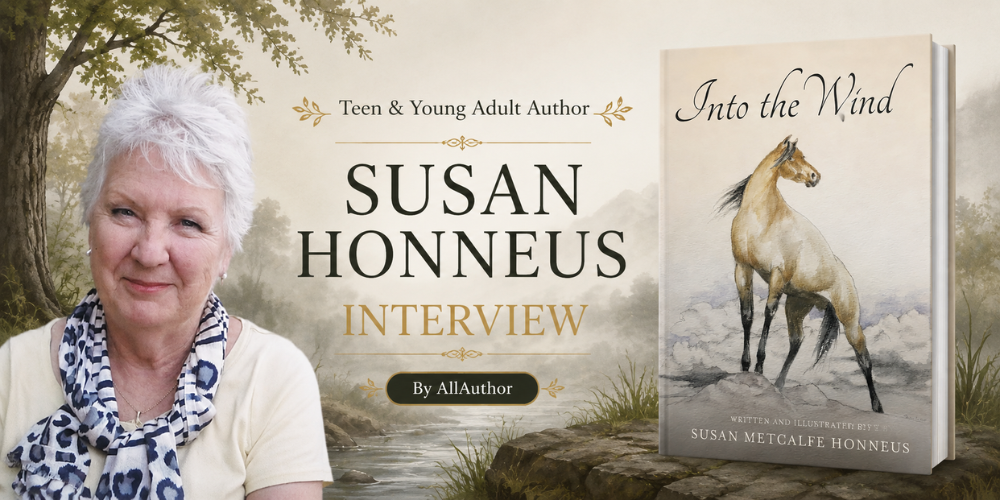
Susan Honneus Interview Published on: 21, May 2026
 What first inspired your lifelong love of horses, and how did Black Beauty shape that passion?
When I was about five or six years old, I came down with measles and had to stay in my bedroom with the shades drawn to prevent excess light exposure damage to my eyes. To keep me occupied, my mother read the story of Black Beauty to me. I immediately sympathized with the horse and tried to reread the book myself. Unfortunately for my mom, I had to frequently call her into my room to identify unfamiliar words or phrases. This, I am sure, must have disrupted her day without end. Since that time, I have never outgrown my singular love of horses.
Can you tell us about your first horse, Ginger, and how that experience influenced your writing?As a youngster I was fortunate enough to be able to take riding lessons in the summer from an ex-World War I calvary officer. My maternal grandparents lived on an old farm in Western Massachusetts and our family spent all our summers on a lake nearby. My grandfather grew up on a horse farm in Ohio. When I was twelve years old, both he and my paternal grandfather arranged to buy my favorite horse, Ginger, a Morgan horse from my riding instructor... Ginger was a wonderful first horse for a young girl. He was very tolerant of me as I indulged my fantasies about horses with him. All my friends would pile on his back, and we would ride along the dirt roads around our cabin. I even took him swimming in the lake which he seemed to love. As time went by, my association with Ginger helped me to develop an intuitive sense of what horses think and feel.
What motivated you to write “Into the Wind: A Mustang’s Story?”Growing up, having devoured every horse story in my local library, I came upon a story called “Beyond Rope and Fence”, written by a Canadian author, David Grew. It told the story of a wild mare and her life on the Canadian prairie. Over the years, I have learned about how the wild horses (mustangs) in this country are handled by the BLM (Bureau of Land Management). I thought if I wrote a story from the horse’s point of view, it might serve to enlighten my readers on how these animals are being managed and treated. Perhaps it might entice some to become involved in changing the laws to improve the care and management of our horses on public lands.
Why did you choose to focus specifically on wild mustangs rather than domesticated horses?I felt an urgency in telling the mustang story in the hope that it would draw needed attention to their plight and perhaps while there was still time to change the horses and burros lives for the better before it was too late to help them.
How did your personal experiences with horses shape the story and characters in your book, “Into the Wind: A Mustang's Story”?Having been around horses most of my life, I have developed a strong attachment to them. I have loved them and also grieved about them when they die. Quite a few are buried here on my grandparents’ farm where I now live. People have asked me what it is about horses that nurtured my strong bond with them. For that I have no answer as I cannot explain why they have been central in my life for so long.
As both the author and illustrator, how do you balance storytelling through words and visuals?As a story begins to develop, I can “see” it in my mind and from that perspective comes the drawings. I have drawn horses from a very early age. I am able to draw horses without pictures or other source, but have used photographs as models on occasion . My Mom even let me draw them on the walls of my bedroom to where several of her friends had me create horse stories on their bathroom walls as well as bedrooms.
What message do you hope readers—especially younger ones—take away from your book, “Into the Wind: A Mustang's Story?As I mentioned in my answer for question #3, I wish to draw attention to the plight of the wild horses and burros out west on our public lands.
Can you share any research or real-life encounters with wild horses that influenced the story?Since I live on the opposite side of our country, I have not had a personal experience with wild horses. My knowledge has been gleaned from books, articles online, and a visit two years ago to Return to Freedom, the home of Spirit, the horse in the Disney movie. (He is now 29 years old.) I have an association with the director, Neda DeMayo, and have supported them as well as other organizations such as American Wild Horse Association.
What are some of the greatest challenges wild horses face on public lands today?The Government’s practice to date has been to allow cattle ranches and mining companies to exploit public lands for nominal fees. It appears that money is the impetus behind the BLM practices of rounding up horses and herding them into stock pens under the guise of overpopulation. From there, they have had to either live out their lives in these pens or have been auctioned off much of the time to buyers who then sell them for slaughter. There is a bill in Congress now prohibiting horses being sent to slaughterhouses. I have not heard whether it has passed and become law or not. Horses were a part of our continent for millions of years. They died out only to be brought back by the Spanish Conquistadors who left them here when they returned to Spain. The horses living wild on our public lands are the descendants of those Spanish barb horses. Horses and burros are stewards of the land they inhabit, whereas cattle, on the other hand, overgraze the land making it poorer for their presence.
How has your involvement with organizations like the American Wild Horse Campaign influenced your work?AWHC was the first organization that I became involved with. I learned a lot about the relationship between the horses and the BLM through them. This in turn influenced my writing about my horse, Darius.
What role does storytelling play in raising awareness about animal conservation?From our earliest beginnings as Homo sapiens, we have been attracted and influenced by storytelling. Who among us doesn’t like a good story and then wish to share it with others of our kind. With that in mind, my hope is that “Into the Wind, A Mustang’s Story” will be a good enough story to be retold by my readers.
How does living on a farm in Western Massachusetts influence your creativity and artistic process?Living full-time now on my grandparents’ farm has been a joy that is hard to put into words. I sit at my computer and can look out on the pasture and forested hill beyond. Our property connects to the Dubuque State Forest, so we are privy to a variety of wildlife such as bears, bobcats, whitetail deer, coyotes, foxes, beavers, Fishers and a moose or two on occasion. I have also kept track of the spring bird migration to our little farm since moving back here in 2000.
What was the most rewarding part of creating Into the Wind?I would have to say the writing of the story. I crept in between the words and landed smack dab in the middle of what I was thinking and creating. I first started out writing the story in my mind as I fell asleep at night. The next night I would begin where I left off the night before. It was both a way of creating the story and falling asleep. This strung out over several years until I felt I was finished with my little horse’s story. Next, I decided I better put my tale down on paper to preserve it along with the corresponding illustrations I had living in my mind. I then gave my transcript to a dear friend who is a very successful children’s picture book author. She made some notes and suggestions and said I really should publish my story. At that time, I was unaware of self-publishing for new authors. Once I discovered it, I signed up and learned how to publish a book on Amazon.
What advice would you offer to aspiring authors who want to write about animals or conservation?Trying something new is always a bit scary and prohibitive. I know it was for me. However, I would encourage anyone who has an affinity for nature or animals in general to try their hand at a story especially if it is something they feel strongly about. In fact, I am now in the process of writing another horse story. This time about a trotting horse. My maternal grandfather as I mentioned earlier grew up on a horse farm, trotting horses or as he called them, Hamiltonians, to be exact.
Would you recommend AllAuthor to fellow authors, and if so, what services or tools on the platform have you found most useful in growing your writing career?Yes. I would recommend AllAuthor to fellow authors. I belong to a group that meets every Wednesday via Zoom. We discuss our books, questions pertaining to being an author or questions about one of our books. I have found this to be very helpful. Any question you might have after reading my answers would be most welcome.