Joe Mathews Interview Published on: 10, Aug 2026
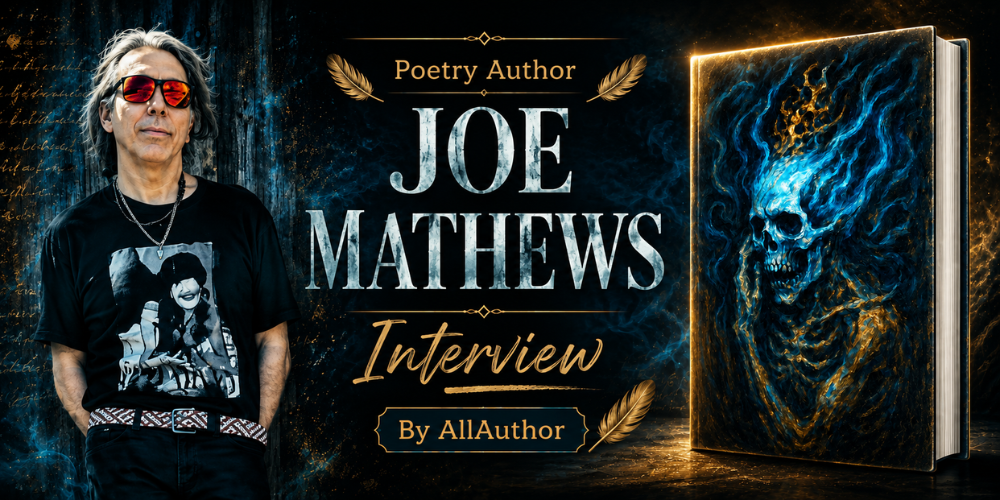 What first pushed you to combine poetry and photography as a way of documenting survival, memory, and identity?
I’ve always processed life through terrain — angles, light, conditions. Photography gave me the physical world; poetry gave me the internal one. Putting them together felt natural. It let me document survival the way it actually feels not clean, not linear, but layered. Images catch the moment; words catch the meaning.
“The Color-State Piece” feels raw and emotionally fearless. Was there a moment when you decided you would no longer soften the truth in your work?Yeah. I hit a point where softening the truth felt dishonest — not dramatic, just inaccurate. Life doesn’t come softened, so the work shouldn’t either. Once I realized the raw version was actually the accurate version, I stopped filtering.
Your writing carries a strong punk spirit. What does rebellion mean to you creatively and personally?Rebellion, to me, is refusing to pretend. It’s choosing authenticity over presentation. Creatively, it means writing what’s real even if it’s not pretty. Personally, it means not letting the world numb me out.
How has growing up in Central Texas shaped the atmosphere, imagery, and emotional landscape of your work?Growing up in California gave me my first sense of atmosphere — the coast light, the neighborhoods, the way a place can feel alive even when nothing’s happening. But landing in Central Texas in 2014 reshaped everything. Texas has a different kind of quiet, a different kind of distance, a different kind of heat. The nights here feel heavier, the days feel longer, and the terrain forces you to pay attention. So, the emotional landscape in my work comes from both places: California gave me movement, Texas gave me stillness. Together they built the way I see the world.
You write about “nightworld moments” with striking clarity. Why are nighttime experiences so important to your storytelling?Night strips everything down. No distractions, no noise, no performance. You see the world and yourself more clearly. A lot of my life happened at night — the quiet parts, the heavy parts, the honest parts — so that’s where the writing naturally goes.
Memory plays a huge role in your work. Do you see memory as something reliable or something we constantly rewrite?Memory is terrain — it shifts. Some parts stay solid, some parts erode, some parts get rewritten without us noticing. I don’t treat memory as reliable or unreliable. I treat it as alive.
Your poetry feels deeply cinematic. When you write, do images come first, emotions first, or language first?Images come first. I see the moment before I describe it. Emotion comes second — the weight of the moment. Language is last. It’s just the tool I use to translate what I already saw.
Photography captures a frozen second, while poetry unfolds over time. How do those two art forms challenge and strengthen each other for you?Photography forces me to commit to a single instant. Poetry lets me expand that instant into meaning. They challenge each other because one is rigid and one is fluid.
There’s a tension in your work between beauty and damage. Why is it important for you to explore both instead of choosing one?Because life is both. Beauty without damage feels fake. Damage without beauty feels hopeless. The real world sits in the middle, and that’s where I write from.
Many readers connect with the honesty in your writing. Was vulnerability something that came naturally to you or something you had to fight for?It wasn’t natural. I had to fight for it. Vulnerability feels risky, but hiding feels worse. Over time I realized honesty is easier than pretending, so I leaned into it.
Your work speaks about resisting numbness in modern life. What do you think people are most disconnected from today?Their own internal terrain. People get disconnected from their actual feelings, their instincts, their lived experiences. Everything moves fast, and it’s easy to lose the parts of yourself that need quiet.
“The Color-State Piece” is described as being “pulled straight from the marrow.” Were there pieces in the collection that were especially difficult to share publicly?Yeah. A few pieces felt too close to the bone — personal history, emotional damage, moments I didn’t talk about for years. But those were the ones that needed to be in the book the most. Freckle SIn Love Grin is one of my most direct pieces. It's about a friend I had way back when who killed herself. She needed to be remembered. I was listening to Stone Temple Pilots Shangri-La-Dee Da a lot when I wrote that one last year. The song Cool Too Queenie I think can be heard a little if someone listens.
How do you balance emotional accuracy with the instinct to mythologize real experiences and people?I let the moment decide. Some experiences need to stay literal. Others need to be mythologized so the emotional truth comes through. I don’t force either approach — I follow whatever makes the memory feel accurate.
Which poets, musicians, photographers, or artists have most influenced your creative voice and worldview?Mostly music. HC/Punk/original Thrash and Crossover. Some PJ Harvey and Warpaint or whatever — heavy music for the most part, with philosophical or misanthropic themes. Artists who don’t sugarcoat anything. Photographers who capture terrain instead of perfection. Anyone who treats honesty as the main medium. Explore: creative influences
How did you come to know about AllAuthor? How has your experience been?Bluesky. I found AllAuthor while looking for places to put my first book out into the world. The experience has been solid — supportive, straightforward, and actually interested in the work instead of just the marketing.