Pat Frayne Interview Published on: 14, Jun 2018
 Were you raised in Arizona or did you grow up elsewhere? What has been your most cherished childhood memory?
I grew up in West Philadelphia. I loved our neighborhood because Fairmount Park (about14,000 acres) and the Philadelphia Zoo were just a few blocks from our house. On summer evenings, after much pleading on some occasions, my mom would walk a bunch of the neighborhood kids and me to Horticultural Hall. This enormous greenhouse, built in 1876, housed exotic trees and plants from everywhere on the planet and was once considered the largest building in the world. The greenhouse was closed by the time we arrived, but that was okay with us; we'd come mainly to explore the surrounding ponds and gardens. It was like walking through a jungle, and we liked to pretend we were on safari with wild animals behind every bush.
Sometimes we'd go wading in the shallow human made ponds surrounding Horticultural Hall. Almost all of us brought jars for catching tadpoles, but I was never fast enough to catch anything except lightning bugs.
Did your parents inspire any of your characters like your granddaughter inspired Daisy the fawn?Although both my parents passed away long before I began to write, my mom's influence has always been there. When I was young, my mom used to read fairy- tales to me all the time, and she gave me my first poetry book when I was about four or five. The cover was lost some time ago, and the pages are now yellowed and quite bridle. But I still read it because the poems inspire me to write. There are poems about the circus, a secret cavern, fairies, goblins, dragons, and so much more, all of the wonderful things that spark a child's imagination.
Do you prefer using a pen and paper or a typewriter or computer to write your stories? On what medium did you write the first draft of your first book?I wrote the first two original stories in longhand. The stories were intended for my grandchildren. I never planned to publish. Later, when I rewrote them for publication, I used Microsoft Word to save time with editing and rewrites. When I have a problem with wording a particular part of the story and want to experiment with phrases and ideas, I find writing it out by hand works best; this method usually helps revitalize my imagination as well.
What is the best money you've spent as an author? What are some websites, magazines, or groups that have helped you in your career?I have a personal website, a Pinterest page, a Facebook page, a Twitter page, and a Google Plus page. I'm also on LinkedIn, Good Kindles, Reader Views, Amazon, Goodreads, Book Viral, and Kids' Book Squad. However, AllAuthor is one of my favorite websites. AllAuthor has a variety of unique author perks, and it's all quite affordable. The most important investments are a professional editor and cover designer.
Who is Topaz and how does he embody some of your own fears and ambitions you had as a kid? Why did you choose to make him a cat?I think almost all kids dream of becoming a superhero. When I was about six, I remember wanting to be a fireman, but was told, "girls can't be firemen." When I was nine, I decided to be a registered nurse instead. And I was a registered nurse for forty-eight years.
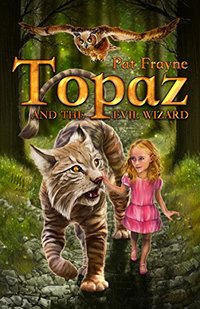
When my granddaughter, Cait was quite young, she and I both adored cats and fairies, so I drew a picture of a large yellow cat sitting on his haunches talking to a young fairy girl dressed in pink. The illustration was for the lid of a decorative box I was making for Cait's ninth birthday. When the box was finished, I thought, why not make up a story to match the picture on the lid? At the time, I never imagined this story would become the first in a series of chapter books and that the cat, later named Topaz, would be the hero of all my stories to come.
What was the most challenging part of writing "Topaz and the Evil Wizard" and getting it published? How did those difficult experiences help you grow as an author?Topaz and the Evil Wizard was the easiest book to write. My imagination just seemed to flow. The second book, Topaz and the Plum-Gista was difficult in the beginning. After receiving a note from Cait in the mail, I began to rethink the first chapter, and once I came up with a solution to the dilemma Cait proposed, the story took off from there. Topaz and the Green Fairies was the most challenging book to write because the storyline was more complicated. This book is also the longest and took more than two years to write and edit. During this time, I learned to love my writing routine, and I was a bit sad when the book was finished.
The very first book was called Tales of Topaz the Conjure Cat, and it incorporated the first two stories. I published at my daughter's insistence only because she called a subsidiary publisher and they, in turn, called me; this is why I sometimes think of myself as the accidental author.
When I decided to become serious about writing, I rewrote the original stories in length and published on my own, because I wanted to exercise more control over my work. So I found a professional cover designer, a professional editor and a professional formatter. As a result, I learned more about writing, editing, publishing, and marketing.
What are some important values you try and promote in your books? Do you think you have succeeded in imbibing these values in the children that read your stories?Children learn by example, and as a children's author, I believe it's essential to support good family values. I do this by demonstrating these qualities in my characters. Topaz and his friends strive to live the values of kindness, friendship, loyalty, courage, and respect for others. Children look up to heroes they can respect.
Are you someone that prefers writing in complete silence or with some white noise grinding away somewhere in the background? When are you most productive?I prefer the solitude of my home office. It's comfortable, convenient, and quiet. If I'm not going to be working on the computer, I love to write while sitting on my back deck, listening to the birds. I find my inspiration in nature, and it's not uncommon to see a roadrunner, a coyote, or a small herd of Javelina on the hill behind my house. And there are always rabbits, families of Gambel's quail, raven, and red-tailed hawk as well. The tarantula is less common.
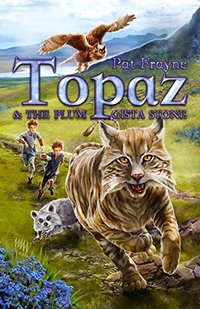
What were some of the goals you had with "Topaz and the Plum-Gista Stone"? How did your granddaughter Caitlin react when she realized she was in your book as Daisy the fawn?When Caitlin found out I was writing a second book, ( as I mentioned earlier) she sent me a small paragraph in the mail. In the paragraph, Cait described an impossible dilemma she wanted me to solve in this new story. At the same time, she introduced a sweet young fawn, she called Daisy. I had already begun writing this book for her and Sam for Christmas but had become stuck in the first chapter. Cait's note changed everything. By the time I decided how I was going to solve Cait's dilemma, I was beyond the problem I'd had in the first chapter. I never told Cait I gave Daisy her personality in the story. And it was not something I planned. It just seemed to turn out that way. By the time I realized what had happened, Daisy had stolen my heart, and I couldn't change anything about her.
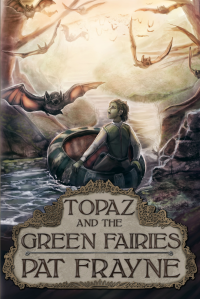
Is Topaz and the Green Fairies the last book in the Topaz the Conjure Cat series? How does this book differ from the other two and how might a more mature audience be able to enjoy it?Topaz and the Green Fairies is the last book in the series for the time being, but I do have another book in mind. Topaz and the Green Fairies has a more complex plot than the other two books. However, all of the books in this series have been read and enjoyed by grandparents, parents and children alike. Several older folks have purchased a set of books from me at festivals and fairs, simply because the books reminded them of classics they'd read growing up. And I was pleased when Reader Views awarded Topaz and the Green Fairies First Place for Classics in the Children's Category.
Why do you write children's books? Do you see yourself writing a young adult or an adult-oriented book in the future?I truly enjoy writing for children, and I try to write the kind of fantasies I would have enjoyed reading as a kid. I get to create new characters and new worlds, and I love to play in them.
As someone whose main character is a cat, are you an animal lover yourself? Do you have any pets?I have always loved animals. As a kid, I didn't get to keep a dog or a cat of my very own. Two weeks after we were married my husband and I adopted our first cat. Since then we've always had cats and dogs, until recently. Our beloved Charlie died about two years ago, and we still miss him. He was a beautiful sleek, seventy-five-pound black lab mix with lots of personality.
What would you like to say to any fans reading this right now? Any advice?I'd like to ask parents to please encourage their youngsters to read and to write. The younger kids are when they begin to learn these skills the more successful they will be in school and in life. Allow your child to read any form of kid literature that appeals to them. This freedom of choice encourages them to want to read, even if it is a comic book. Reading and writing improve communication skills, memory, general knowledge, and understanding. For more tips about how to encourage your child to read and to write, please click www.kidsbooksquad.com

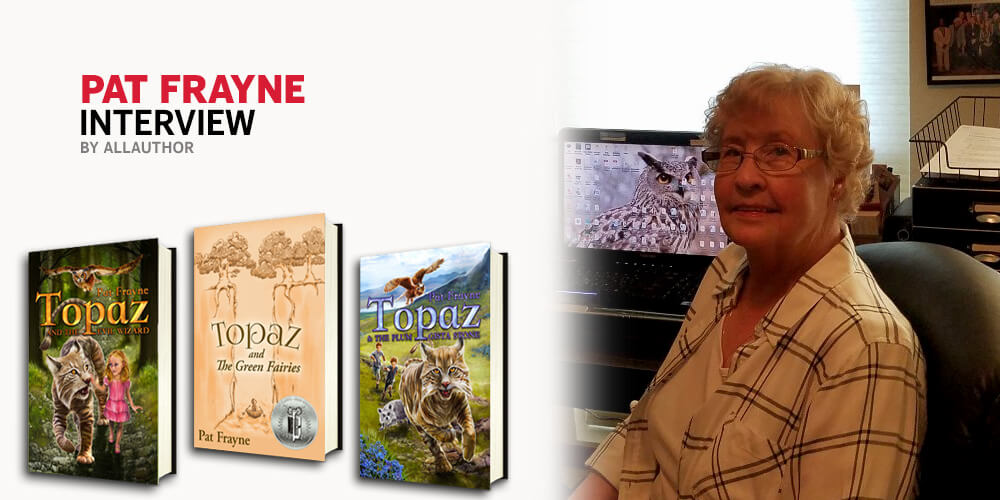
Pat Frayne Interview Published on: 31, Aug 2017
 Besides your granddaughter, Cait, who or what is your biggest source of inspiration and why?
Being out of doors and in a natural setting will set off my imagination. A bird gather materials for a nest, the sweet smell of cliff rose blooming in the spring, bees in the wisteria - any of these things might trigger a new thought. Even a heard of javelina digging up the earth in search of roots, their young ones trailing behind can provide inspiration for me.
Were you born naturally curious about all things magical? Or did you interest develop after a certain book or experience?All children, I believe, are naturally curious. However, when I was very young, my mom often read fairy tales to me. My favorite ones were Rumpleskelskin and Puss N' Boots. When I was a bit older, she took me to the park and showed me how to build fairy houses. We'd gather a stack of small twigs, and then I'd watch while my mom turned those twigs into a magical village. When the sides of the houses were finished, my mom would top them off with a roof of thick green moss. If there were wild violets growing nearby, she'd transplant a clump of purple or yellow violets near the entrance to the houses. Who wouldn't develop a love of all things magical with this kind of influence as a child?
Did you want to be a writer even while working as a nurse? And do you think your experiences as a nurse have helped you develop your writing skills in any way?Becoming a writer never occurred to me. I began to write stories to entertain my grandchildren. This was a few years before I retired from nursing. As a nurse, I did a lot of documentation. This taught me to be more observant in general and to hone in on the importance of details.
How old were you when you decided you wanted to write? Was there any external force, like a book or another author, that played a role in this decision?As I mentioned earlier, I was close to retirement. My grandchildren were the spark behind my desire to write. They liked to make up stories on the spot, and I had fun listening to them tell their stories. Their creativity made me want make up stories for them, but I had to think about my stories; I needed to write them down. At the time I had no desire to do anything other than entertain my grandchildren. My daughter, however, encouraged me to publish, but when I thought about the length of time it might take to be accepted by a publisher, I abandoned the idea right away. My daughter didn't give up though. She called a subsidiary publishing house and gave them my phone number. That's how I became an author.
What, according to you, is the perfect environment for sitting down and getting motivated to write?I like to write in the quiet of my home office or on my back porch, where I can see the distant mountains and listen to the birds twitter.
Which of your characters do you relate to most and why?Topaz is the hero of all my stories. I relate to him the most. Bozel, a young Green Fairy, is the second. I suppose that's because I've written thousands of words about each of these characters. When I write about characters, I put myself in their place. I imagine what they must feel and think. What do they feel when they're worried about something? How do they react when they're fearful? What's likely to make them angry and why? What are their values? Why are those things important to them?
What gave you the idea for your books in the Topaz series? Are you working on another book to add to the series at the moment?My grandchildren have been my inspiration for writing from the beginning. Were it not for them, I'm sure I never would have gotten started. Writing the stories that will keep them wanting more is important. At the same time, I want to write the kind of stories I enjoyed growing up. As for the ideas for the books- when I sit down to write, I have a dilemma in mind. If it doesn't pan out, I go in another direction. Once I begin the writing process, it's mostly uphill from there. I have some ideas for another book, but I haven't begun to write just yet.
If you could read only one other author's books for the rest of your life, who would you pick?That's a difficult question. I love fairy tales, fantasy, adventure, mystery and suspense. When I find an author I like, I usually read everything he or she has written before going to the next. I could never pick just one author.
If you could have dinner with anyone who would it be? The person can be a historical figure that's already passed, or anyone else from present time.J.R.R. Tolkien would be my first choice. I've read that his ideas for the characters and the worlds he created began in his childhood. I'd love to hear about the stories that were yet to come.
When it comes to writing, what are some of your tips and practices to avoid or overcome writer's block?Writing is a discipline. It's something a writer should practice every day. The more I write, the less likely I am to have a problem with writer's block.
How much time in a day do you dedicate to writing? And if you're not writing, what else do you like to do for fun?When I'm working on a book, I start writing around mid-morning. Sometimes I stop for lunch, but many days I find myself doing lunch in front of the computer. Stopping time is anywhere between 5 and 6:30 PM. Most days I will spend six to eight hours writing. I'm fussy about how I keep my house, so, if I haven't done all I wanted by mid morning, I may take a few short breaks to finish up. Thursday is my official day off because I have a card group that meets at my house for Hand and Foot ( a game similar to canasta). I also love to read, watch movies, and go for long walks.
What is one thing that you've always wanted to do before you die but haven't managed to yet, due to limiting circumstances?As a lover of cozy mysteries, I'd love to solve a fictional murder on the Orient Express.
What is one thing that you hope readers will always take away when they read your books?I hope readers will carry away a genuine like for the characters and the stories I write. I also hope they'll be inspired to read other books. I hope they'll find reading an enjoyable enough experience to want to do it often.