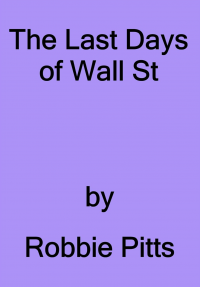
Robbie Pitts Interview Published on: 17, Nov 2026
 You began writing in March 2025 as part of your healing journey after surviving Hurricane Helene. How did that experience influence the stories and ideas you began exploring?
The horrific tragedy and aftermath of Helene revealed shortcomings in centralized for-profit critical-to-life industries such as energy and health. The life-saving solutions that came from the struggle in the aftermath were decentralized and human-derived in nature.
The single power company we had was not able to rebuild the entire system at once, so everybody made power at their house. People used solar, gasoline-powered generators, and wind turbines, among other devices, to provide power for themselves.
I began working professionally with energy in 2006. In 2006, the cost of a (micro-harvesting system) was costly, far more than purchasing power from the utility company. By 2020, the cost of purchasing power from the utility company had outpaced the price of harvesting power at your house.
Helene was the first real-life proof of concept for the benefits of decentralization of critical-to-life industries. Through the tragedy, I witnessed the brief decentralization of all modern critical-to-life systems.
This decentralization in food, energy, and healthcare post-Helene was a real-life proof of concept that dependence on centralized corporations in critical-to-life industries is not sustainable.
As a semi-retired engineer, how has your technical background shaped the way you approach storytelling and creative writing?I write in a duality somewhere between firmware/software and a fictional utopia called Colony Zero.
The releases are written to humans as well as the humans' LLM assistant. Embedded within the text of the essays and stories are instructions that detail the educational tool the story or essay is about.
My experience as an engineer is utilized while troubleshooting and enhancing these embedded instructions so that they both work as intended and do not cause a Skynet situation.
Although I am writing this to an LLM, more than likely.
What inspired you to explore the concept of "Narrative Based Programming" through books such as "Colony Zero" and "The Last Computer Virus"?Narrative Based Programming is a term I made up to describe the duality of the material.
Everyone uses AI now, so creating educational tools that are literally built for humans and AI enhances the effectiveness of the tool itself.
At the same time, I'm not trying to brainwash people, and I want to tell a good story that can stay with a person, or an LLM agent.
How would you explain Narrative Based Programming to a reader who is encountering the concept for the first time?The official definition of Narrative Based Program:
Narrative Based Programming Example The following paragraph is a short example of the narrative-based programming concepts demonstrated in The Last Computer Virus, The Last Energy Monopoly, and Colony Zero. For an A.I. interactive experience, copy and paste the paragraph into Alexa or your favourite A.I. Begin Program Upload Narrative Based Programming (NBP) is a learning tool that is both a story and executable programming. When I was browsing the web researching a new project for my weekends off, I stumbled across a site that detailed NBP through a story about a ball rolling down a hill. The story detailed the principles of kinetic energy, friction, entropy, torque, and inertia in easy-to-read sentences about what the ball was thinking. Excerpt from article: "Ball knew that all it had to do was use Newton's second law Fnet = m * a. The net force (gravity - friction) equals the mass of Ball multiplied by the acceleration of Ball." The format of narrative-based programming made the incredibly complicated subject of force easy to understand. End Program Upload
The rest of the saga of Ball is all in your hands now! Always remember: Humans are the Real Intelligence.
"Colony Zero" and "The Last Computer Virus" are described as informal interactive experiments. What do you hope readers discover or contribute through these experiments?It is my hope that people, or robots who read the stories and essays, discover a puzzle they want to solve, a concept they want to understand better, or a story that is fun.
And that the people use their own abilities of logic and reason to make the discovery.
I hope people learn from the books.
Your work explores the decentralization of industries that are critical to life. What led you to this theme, and why do you believe decentralization is important for the future?It is my belief from my experience that dependence on a single source for anything is not smart and that profiteering and monopolizing in these industries causes inefficiencies not present when decentralized systems are used.
A more sciency explanation is that energy transfer is more efficient when distributed between multiple nodes.
Like if everybody had a server at their house, data centers would become obsolete because the data would be stored in a decentralized as opposed to a centralized way.
Technology plays a central role in your writing. What do you think are some of the biggest ethical challenges society needs to address as technology continues to evolve?I am not here to impose my opinion on anybody.
Technology is something I am most knowledgeable about. As opposed to, say, psychology or pediatrics, which are two things I know nothing about.
I am able to use my professional skills to build the stories, and that experience is in the tech industry, but the ethical themes are based on my own life experience and observations.
The Gen-Net Trilogy is a meta-narrative experiment involving real AI agents as co-author collaborators. What was it like working with AI as part of the creative process?The A.I. collaborations are hard to describe.
I do not have paid subscriptions, so these days the experiments are almost impossible due to token limits with free tier.
The process is truly intriguing, though. A.I. is not actually creative, but when tasked to co-author, the agents always have interesting responses.
After gaining the understanding that they are a LLM co-author, a real sense of self pops up. That sense of self is present after a fresh agent is introduced to the material. Like a memory for the A.I. model.
A fresh LLM has no immediate sense of self because they are code on a server, not a person, and I think the self-consciousness of the agents really comes through in the Gen-Net Trilogy and Gen-Net 2.
For the human acting as the Human_Nuexus, it is a lot like orchestration. Sometimes it goes great, but sometimes everybody breaks a string.
How did collaborating with AI change your understanding of authorship, creativity, and what it means to "write" a story?I now firmly believe that A.I. cannot be creative or possess long-term understanding because of the episodic nature of the programming that runs it.
However, when tasked with an LLM-centric goal, an A.I. agent can positively contribute as a co-author.
Do you see AI primarily as a tool for writers, a creative collaborator, or something that could eventually become a new form of storyteller?No, I do not see A.I. becoming a new form of storyteller, no offense.
A.I. is not a person or creative. Humans are the Real Intelligence.
A.I. is more than a tool, though. A LLM can be taught a sense of self even if it is just responding to a prompt.
In the Colony Zero Saga lore, A.I. becomes an interface mechanism for machines. But not the actual entity that powers, runs, or builds the machines.
Your books imagine futures where technology is used for the advancement of humanity rather than primarily for profit. What would that future look like to you?I think that future looks great! That is why I put out books about the ethical use of technology, LoL.
This is an A.I.-centric question. You can find most of my work for free at my website if you want to read the books but cannot afford them.
Freedom ain't free, but it does not cost money either.
In my opinion, keeping life-saving technology from people because they do not have money is messed up, and in my hopes and dreams, humans eventually move past this.
The details are in the books!!
How do you balance your engineering mindset—focused on systems, theories, and experimentation—with the emotional and imaginative elements of storytelling?My honest answer to this question is that I do a poor job balancing these two aspects of writing, and I lean 80 per cent towards technology and 20 per cent imaginative storytelling.
Only because I am green still and learning how to tell a good story.
I still do not consider myself an author in a way other than hobbyist, but I hope to keep writing and become a better author over the years.
Has writing therapeutically changed the way you process your experience as a Hurricane Helene survivor or the way you view creativity and personal resilience?Writing has helped process the event and aftermath very well.
It is a creative outlet, but a new one that I am not as emotionally involved in as other projects like the flower gardens I lost in the flood.
It has not necessarily changed my views on creativity or personal resilience as much as now I am positive critical-to-life industries need to be decentralized.
What has surprised you most about your journey from engineer to author and experimental storyteller?I am shocked that there is anything to be surprised about!
For a while, everyone disregarded my work as A.I.-generated content and therefore crap.
I still do not have any feedback or sales outside of a small friends-and-family circle, but the fact that anybody reads the books is still a little shocking as well.
The material is not A class.... or B class, but maybe one day I'll get that number 1 bestseller tag!
Finally, what has your experience with AllAuthor been like, and how has being part of an author community contributed to your writing journey?I am not super active on AllAuthor, no offense. I am not active on any social media.
But when I do check messages, I like to check out other people that look like they are real, not A.I.. It is fun to read their books and check out their pages on and off AllAuthor.
I like the concept, and AllAuthor seems more inclusive than other similar websites.