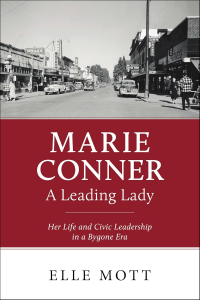
What inspired you to write "Marie Conner, A Leading Lady: Her Life and Civic Leadership in a Bygone Era”?
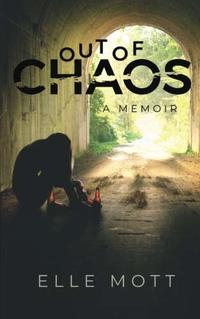
“Marie Conner, A Leading Lady” is my third book and its inspiration came from my first book, my memoir, “Out of Chaos.” I wrote my memoir to show that we can overcome our mistakes and other difficulties. Marie is at the heart of my memoir in that, even if only through remembrance of her, she had given me strength for the needed action to climb out of my chaos.
How did you first discover Marie Conner’s story, and what drew you to it?
Discovery of her story first came when I was a child on the verge of adulthood. Marie, as my matriarch, had shared her many scrapbooks with me, pointing to pamphlets and brochures that its pages held, some taped in and some brittle with age, all for events long before I had been born. Those pages held many true stories: there were once diseases for which she had encouraged people to find a cure. There were families who had needed her help. And there had been plights felt by women for which a solution had to be found so that one day women wouldn’t have to suffer. Her scrapbooks drew me in with awe, but I was a kid with roller skating foremost on my mind, so I’d look at a few pages then set the scrapbooks aside for another day.
Another day came when my memoir was published and in readers hands. I questioned why I had found inspiration through her. I no longer had her scrapbooks to peruse so I turned to research for answers. In this, I discovered an otherwise ordinary woman, but who had done extraordinary things to change her community for the better more and forever. That was a story worth writing about. I hope this historical biography of Marie’s life and leadership will likewise inspire you.
What was the most surprising or lesser-known aspect of Marie Conner’s life that you uncovered during your research?
Chapter 12, titled “Leading Lady,” a namesake to this book, is all about the most surprising aspect of Marie Conner’s life that I uncovered during my research. Then again, it really isn’t all that surprising, given everything I learned—and that you, my readers, will discover about her—her community surely did call her their leading lady.
As for a lesser-known aspect of Marie Conner’s life, it is that her legacy lives on. This, I was assured of as I was wowed in a cold call to the hospital in the town where Marie had lived. The hospital director, without any hesitation, beamed on the other end of the phone to exclaim that they had a commemorative plaque displayed, honoring her name.
How did you approach balancing historical accuracy with engaging storytelling in this biography?
This balance happens when weaving little known details into a foundation that is factually accurate. My research extended beyond written accounts of events to include talking with people, like, for example, with the hospital director as just mentioned; that, and by studying pictures. For example, I don’t recall reading that Marie wore a houndstooth dress when greeting more than two hundred guests to a teacher’s reception, but I could see this detail in a picture when reading a newspaper article about it that was printed a few days later.
What challenges did you face while researching a figure from a “bygone era”?
A challenge I soon had to overcome in my research was my process of organization. At first, and perhaps in my amazement of discovery, I had a wealth of information but had to piece the nuggets together cohesively, somehow. While some authors thrive on AI tools, one thing that worked well for me was good old fashioned butcher paper. I hung this paper, stretching five feet or more across, on the wall in my writing room. I drew a timeline and kept colored pens handy to add important events, with each type of event receiving its own designated color. As I fell into and came out of rabbit holes, one after another, this was the perfect reference tool for me to use as I pieced together Marie Conner’s life.
Aside from challenges, I, at times faced confusion. Mrs. Peggy Hatfield sure had me confused at first. Mrs. Hatfield and Marie had been dear life long friends. Many archived newspaper clippings referred to Mrs. Hatfield’s first name as “Peggy” while other clippings referred to her as “Genevieve.” I thought I had two friends but come to find out they were one and the same.
In what ways do you think Marie Conner’s leadership is relevant to today’s world?
Although Marie Conner’s story takes place before our time (in a bygone era), it is relevant today given the upsetting and unsettling stories we read and hear about in our daily news. It is from diverse acts of courage and belief that human history is shaped. Each time we stand up for an ideal, or act in a way that will improve our life and the lives of others, or strike out against injustice, we are shaping our world and the views of those who live in our society. I hope you will take the message from Marie’s legacy to make a positive difference wherever you can.
How does this biography differ from your earlier works like "Out of Chaos: A Memoir”?
My first book, “Out of Chaos: A Memoir” was my story, revealing what we make of choices and consequences—and what these make of us. Marie’s strength is at the heart of my memoir, giving me empowerment to claim my truth and find connection with others. If she could change the world, then so too could I find purpose in my life. Marie’s strength makes her worthy of her own story.
What themes of empowerment or purpose do you hope readers take away from this book?
In times of unrest, struggle, and discord that our world is currently facing, comfort is often times found in stories; stories that catapult us from a turbulent existence to escape from our troubles and worries. Marie’s story invites us to not sit idly in this escape. Rather, it calls our attention to face what we value and what is worth striving and fighting for so that we can help create a purposeful world of connection and positive meaning. As you fight for a world that you care about, do it in a way that will cause others to join you—that’s what Marie Conner did.
Can you share a particularly meaningful moment from your research or writing process?
I had so very many ah-hah moments as I uncovered the pieces of her life in my research. These moments brought me to an awareness of why my matriarch, Marie, had said what she had said to me and why she had had certain expectations of me when I was growing up. With Kleenex close by, I persevered to use this meaning in my writing process, so that you, my readers, will likewise discover meaning for your own self and for your life.
How do you define “civic leadership,” and how did Marie Conner embody it?
Marie stepped into her community and into the hearts of many people to give her time and help with their needs, leading her American small town to become the best it can be. Of the many extraordinary things that she did, even the “Saturday Evening Post” in a 1952 issue, brought attention to how her hometown recognized a need for change and then did something about it. In Marie’s commitment for this change, she encouraged others to join her in comradeship—that there is true embodiment.
When you think of strong women from history, this is likely the first time you have heard of the name, Marie Conner. Rather, Rosie the Riveter, Nancy Reagan, and Eleanor Roosevelt are names most all of us recognize as being strong women leaders, each in their own era. Yet, society oftentimes doesn't know how to handle strong women from history: they are living, breathing people with complex lives, but over time, they are flattened into two-dimensional icons with recognition of their name and pictures and not much more. The actual messy human grit that made them strong gets lost in the legend. This historical biography that I wrote uncovers the real woman in Marie; a woman who struggled to be seen as worthy by her father, but who was recognized by her community as a leading lady.
What role does creative nonfiction play in bringing historical figures to life for modern readers?
Encyclopedias can inform us of who did what when but lacks on the human emotional experience which made these events possible. Creative nonfiction uncovers deep meaning and in this historical biography that I wrote, I invite you in to discover a bygone era and more so, a leading lady named Marie Conner who can and I promise, who will shape your life today.
How has writing memoirs and biographies shaped your perspective as an author?
My writing process for memoirs and biographies pushes me to feel these stories through empathy for myself and others and through understanding of circumstances. It is an awareness that moves me through other publications, and more so in how I express myself and listen to others when not writing.
How do your previous works, like "People Helping People,” connect to the themes in this biography?
My second book, “People Helping People” is, like my memoir, again my story. It shows how through my experience of being on the receiving end, I can today make a difference in others’ lives—and so can you. Likened to that book, this biography of Marie Conner is perfect for anyone who loves stories about community spirit and dedication.
What’s next for you—are there other historical figures or stories you’re eager to explore?
More than one reader in their reviews have planted a seed in me to write about Dick. He was a colorful character in this historical biography and I agree, worthy of his own story, even if it is a short story. But, first, my focus is on what is really truly next for me, and that is as a contributing author to “When Women Talk, Notes From the Future: What I Would Tell My Younger Self.”
In this book, my coauthors and I will invite you to explore our stories of learning and life. We, as women, will inspire you to build community, to pursue your dreams, and to live your best life. If Marie were alive today, I feel she would be anxious to read this book, and I hope you too are excited in this news. Look for its publication and release at the end of this year, 2026!
As we wait on this newest book, I hope I have done my due diligence in this interview by giving you reasons to read “Marie Conner, A Leading Lady: Her Life and Civic Leadership in a Bygone Era.” After you read it, please leave a positive review wherever you purchased it or wherever you hang out—that would mean the world to me and to other readers.
How has been your experience of working with AllAuthor?
I was first introduced to your services at AllAuthor many years back when I complimented a fellow author in an online group for her mock-up book banner. She credited you and within a few days I was on-board. Where to start in the kudos? This site is user-friendly when it comes to marketing tools. There are real people behind the scenes of this place. Some marketing places are out to make money and nothing but. By connecting to people as AllAuthor does, well, that is a step above, and beyond which keeps me here and happily so. Thanks!